
Tuesday, September 26, 2006
Stamp out IBD
I enjoyed this story about an college freshman who made it his wish to meet with the Postmaster General to promote his idea that there should be be a postage stamp about Crohn's disease and such. Perhaps it would look like this:


Monday, September 25, 2006
SW Virginia theaters
The Washington Post has a page with notes on the Barter Theatre, The Paramount in Bristol, and the Lincoln Theatre in Marion.

Friday, September 22, 2006
On your outrages to personal dignity
I've been reading lately about the proposed legislation related to the Geneva Convention, and an interesting parallel occurs to me as I've also been reading stories like this one in the Bristol paper about the suspension of the football coach for talking rough to the kids.
It sounds like the moms are upset that their boys have suffered "outrages to their personal dignity" of a kind.
My old football coach I liked very much, even though he swore at me a lot and spit when he talked. He's the fellow in this picture. Evidently, he's just separated himself his most recent coaching job, for reasons unrelated to yelling and spitting.

It sounds like the moms are upset that their boys have suffered "outrages to their personal dignity" of a kind.
My old football coach I liked very much, even though he swore at me a lot and spit when he talked. He's the fellow in this picture. Evidently, he's just separated himself his most recent coaching job, for reasons unrelated to yelling and spitting.
Wednesday, September 20, 2006
On the new law school at Greensboro
This press release details Justice O'Connor's appearance at the dedication of the new law school in Greensboro, NC, at Elon University.
Judge Kiser finds subject-matter jurisdiction for pastor's employment dispute
In the state and federal courts, there is an exception to subject-matter jurisdiction for intra-church disputes, the cases noting that for the courts to take sides in a matter of religious dispute would violate the First Amendment.
In Vann v. Guildfield Missionary Baptist Church, however, Judge Kiser denied the defendant's motion to dismiss, concluding that he had at least jurisdiction to decide whether the church had acted to dismiss the plaintiff, where the by-laws required some kind of majority vote and the plaintiff claimed there was no vote at all.
In Vann v. Guildfield Missionary Baptist Church, however, Judge Kiser denied the defendant's motion to dismiss, concluding that he had at least jurisdiction to decide whether the church had acted to dismiss the plaintiff, where the by-laws required some kind of majority vote and the plaintiff claimed there was no vote at all.
Tuesday, September 19, 2006
Oh Captain, my Captain

I read earlier today an article about a law dean called "the Colonel," because some thought he looked like Colonel Sanders, and so I wonder why the law dean when I was a student was not called "the Captain."
Although it appears that both Dean/President Sullivan and Captain Kangaroo enjoyed lounging in their special red outfits, this does not make them Red Staters.

Update on the judicial nominations
ACSblog has this update on the appeals court nominees. Evidently, opposition has emerged to D.C. Circuit nominee Peter Kiesler, as well as Haynes and Boyle, Wallace, Myers and Smith.
Monday, September 18, 2006
Where do closed federal court files go?

I always tell people they go to that warehouse where they stored the ark in Raiders of the Lost Ark.
Actually, I think they go to the regional archive center at Philadelphia.
What do senior-status federal judges do?
The answer, as shown in this article from the Federal Judicial Center website, is just about everything.
The article says in part: "In fiscal year 2005, 322 senior district judges — 32 percent of all sitting federal district judges — terminated 16.5 percent of all civil and criminal cases and conducted 17.2 percent of all trials. In the appeals courts, 91 senior judges — 33 percent of all circuit judges — handled 18 percent of all participations in oral hearings and submissions of briefs."
The article says in part: "In fiscal year 2005, 322 senior district judges — 32 percent of all sitting federal district judges — terminated 16.5 percent of all civil and criminal cases and conducted 17.2 percent of all trials. In the appeals courts, 91 senior judges — 33 percent of all circuit judges — handled 18 percent of all participations in oral hearings and submissions of briefs."
Need for affirmative action won't be achieved in 25 years
This interesting article from Inside Higher Ed says that the 25 years (from 2003) that Justice O'Connor speculated would be sufficient to achieve the goal of integration in higher education, won't be.
Sunday, September 17, 2006
Jim Webb and George Allen both chew tobacco
I had to watch all the way to the end of today's Meet the Press debate to find this out. Allen I knew about, Webb I didn't but it doesn't surprise.
They got this close
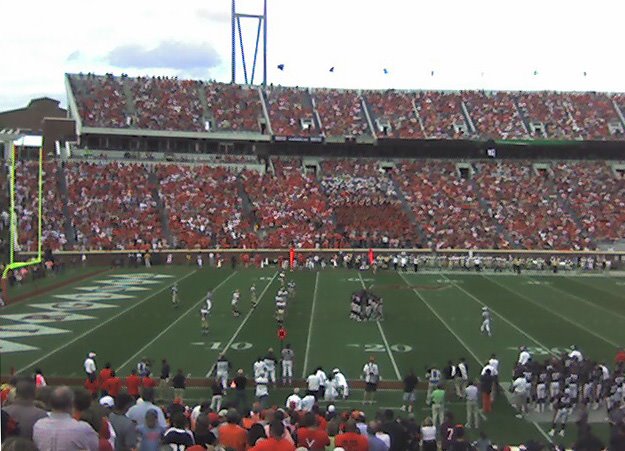
This blurred photo from my Treo shows how close the Cavaliers got to catching Western Michigan yesterday.
The observant reader of Chad's blog will note that my seats are at the other end of the stadium from where Chad sits.
On travels to Southwest Virginia
The two guys I wished they'd picked for the Ryder Cup
Former PGA Champion Shaun Micheel and former British Open Chamption Ben Curtis have both enjoyed a return to form this summer, with Curtis winning the Booz Allen, Micheel the runner-up at Medinah, and both are poised for victory this weekend, with Micheel in the match play finals and Curtis leading the 84 Lumber Classic.
After reading this about the death of his friend Spencer, I wonder whether Micheel has some supernatural backing out on the course this week. (It doesn't look like he'll win this week, but it was memorable nonetheless, as he beat Tiger Woods in the first round.)
For Curtis, this week was to be the last his wife was going to be with him on tour before their first child is due later this month. Instead, she's at home, and he says if he gets the call that the baby is coming, he'll hit the road back to Ohio.
After reading this about the death of his friend Spencer, I wonder whether Micheel has some supernatural backing out on the course this week. (It doesn't look like he'll win this week, but it was memorable nonetheless, as he beat Tiger Woods in the first round.)
For Curtis, this week was to be the last his wife was going to be with him on tour before their first child is due later this month. Instead, she's at home, and he says if he gets the call that the baby is coming, he'll hit the road back to Ohio.
Saturday, September 16, 2006
Chief Judge Wilkins on the death penalty
As described here on the SC Appellate Law Blog, Chief Judge Wilkins of the Fourth Circuit expects that the death penalty will not soon be outlawed in the United States.
The civil rights case of the baseball heckler
Via this How Appealing link, in the case of Swiecicki v. Delgado, the Sixth Circuit reversed the dismissal of a civil rights suit brought by a man who after heckling the Indians at Jacobs Field was booted from the stadium, wrestled to the ground, and arrested for disorderly conduct. The District Court had granted summary judgment to the security guard defendant on various grounds, including the statute of limitations, whether the defendant was a state actor, and qualified immunity.
The ruling on state action might be affected by this Supreme Court filing described on the SCOTUSblog, about another security guard case.
The opinion concludes: "For a baseball fan to make a “federal case” out of being ejected from a game may well strike many as a colossal waste of judicial resources. A jury might well agree. But this is the type of case where the ultimate result is totally dependent on whose version of the facts one believes. Under these circumstances, the grant of summary judgment to the police officer on the basis of qualified immunity is inappropriate."
I guess that's the difference between the major leagues and the minor leagues. In Judge Williams' famous opinion in Simmons v. Baltimore Orioles, 712 F. Supp. 79 (W.D. Va. 1989), the heckler got his in the parking lot after the game at the hands of the player he'd been heckling, and then sued everyone from the parent club on down.
The ruling on state action might be affected by this Supreme Court filing described on the SCOTUSblog, about another security guard case.
The opinion concludes: "For a baseball fan to make a “federal case” out of being ejected from a game may well strike many as a colossal waste of judicial resources. A jury might well agree. But this is the type of case where the ultimate result is totally dependent on whose version of the facts one believes. Under these circumstances, the grant of summary judgment to the police officer on the basis of qualified immunity is inappropriate."
I guess that's the difference between the major leagues and the minor leagues. In Judge Williams' famous opinion in Simmons v. Baltimore Orioles, 712 F. Supp. 79 (W.D. Va. 1989), the heckler got his in the parking lot after the game at the hands of the player he'd been heckling, and then sued everyone from the parent club on down.
Judge Jones allows punitive damages at 15,000 to 1, where the compensatory award was $1
When I first heard about the verdict in the case of Givens v. O'Quinn, I thought there was no way the punitive damages would hold up. The jurors awarded first $0 then $1 as compensatory damages, but $5,000 and $15,000 in punitive damages against the defendants.
In a post-verdict opinion, however, Chief Judge Jones explained that the ratio of punitive to compensatory damages is not dispositive when only nominal damages are awarded, and proceeded to deny the defendant's challenge to the punitive award.
In another part of the opinion, the judge rejected the defendants' arguments about error in the jury instructions, because the lawyers failed to make timely objections. I have always tried to raise every possible objection to jury instructions but what usually happens is that the Court will act on the valid objections and fix the instructions, and the bogus objections don't do any good, and so we have not had a case that was appealed where the appeal turned on some legal issue related to the instructions.
In a post-verdict opinion, however, Chief Judge Jones explained that the ratio of punitive to compensatory damages is not dispositive when only nominal damages are awarded, and proceeded to deny the defendant's challenge to the punitive award.
In another part of the opinion, the judge rejected the defendants' arguments about error in the jury instructions, because the lawyers failed to make timely objections. I have always tried to raise every possible objection to jury instructions but what usually happens is that the Court will act on the valid objections and fix the instructions, and the bogus objections don't do any good, and so we have not had a case that was appealed where the appeal turned on some legal issue related to the instructions.
Another state creates ethics problems for law bloggers
According to this Ars Technica post, authorities in New York have decided that law blogs are lawyer advertising.
I'm not sure that all law blogs are created equal when it comes to whether they should be considered a form of advertising. According to Alton, this blog supposedly made the RK enemies list, whatever that means. If the blog turns people off instead of turning them on, is it advertising? On the other hand, being on RK's boo-hoo list might be a badge of merit in some circles.
I'm not sure that all law blogs are created equal when it comes to whether they should be considered a form of advertising. According to Alton, this blog supposedly made the RK enemies list, whatever that means. If the blog turns people off instead of turning them on, is it advertising? On the other hand, being on RK's boo-hoo list might be a badge of merit in some circles.
Friday, September 15, 2006
Two really interesting opinions this week from the Virginia Court of Appeals
In Anderson v. Com., the Court of Appeals in a wide-ranging opinion by Judge Kelsey affirmed the defendant's conviction for a 1992 rape and robbery that was based on DNA evidence. The defendant was arrested on similar charges in 2003 and DNA samples taken at that time led to a match in the Commonwealth's DNA databank. The defendant raised a number of interesting issues, including whether the taking of his DNA violated his Fourth Amendment rights, whether the delay in his prosecution violated his due process rights, and whether the failure to present all the witnesses necessary to prove the chain-of-custody of the DNA violated his right to confront his accusers under the Sixth Amendment. In addition, the defendant argued on the robbery charge that after he raped her, the victim willingly gave up her purse, which prompted Judge Kelsey to write in response: "Under this theory, a thief who threatens to shoot a victim before taking her money commits robbery. But a thief who first shoots the victim and then asks for her money does not, apparently because the inherent intimidation of being asked for money by someone who has just shot you should be dismissed as a matter of mere timidity. Suffice it to say, violence immediately preceding a demand for money has always been understood as sufficient to convert mere thievery into robbery."
In O'Connell v. Com., the Court of Appeals in an opinion by Judge Beales rejected the defendant's attempt to rely on the victim's contributory negligence as a defense to the charge of involuntary manslaughter, where the victim died because he wrecked while in a drag race with the defendant. The opinion addresses the law of several states in reaching the conclusion that contributory negligence may only in some limited way go to the issue of causation, but in this case, "a driver’s losing control and crashing is a “reasonably foreseeable” result of a drag race."
In O'Connell v. Com., the Court of Appeals in an opinion by Judge Beales rejected the defendant's attempt to rely on the victim's contributory negligence as a defense to the charge of involuntary manslaughter, where the victim died because he wrecked while in a drag race with the defendant. The opinion addresses the law of several states in reaching the conclusion that contributory negligence may only in some limited way go to the issue of causation, but in this case, "a driver’s losing control and crashing is a “reasonably foreseeable” result of a drag race."
Upholding the constitutionality of the Virginia alcoholic beverage laws
On Monday, in the case of Brooks v. Vassar, the Fourth Circuit in an opinion by Judge Niemeyer, with Judge Traxler concurring in part and District Judge Goodwin concurring in part, upheld the constitutionality of two Virginia statutes: Va. Code § 4.1-310(E), which provides an exception to the three-tier import restriction for consumers who personally carry into Virginia no more than one gallon (or four liters) of alcoholic beverages for personal consumption; and Va. Code § 4.1-119(A), which authorizes state-owned and -operated ABC stores to market and sell only wine produced at Virginia "farm" wineries.
In addition, "[w]ith respect to challenged provisions of the ABC Act that permit in-state producers of wine and beer, but not out-of-state producers, to bypass the three-tier structure and sell directly to in-state retailers and consumers — Virginia Code §§ 4.1-112.1(B); 4.1-207(4),(5); 4.1-208(1),(7) — we conclude that Virginia legislative amendments enacted while this appeal was pending render the challenge to those provisions moot and therefore bar us from considering the district court’s order and the amended provisions."
Finally, the Court agreed that the case could be brought under 42 U.S.C. 1983, such that the prevailng plaintiffs on the issues the Commonwealth did not appeal could claim their attorney's fees under 42 U.S.C. 1988.
In addition, "[w]ith respect to challenged provisions of the ABC Act that permit in-state producers of wine and beer, but not out-of-state producers, to bypass the three-tier structure and sell directly to in-state retailers and consumers — Virginia Code §§ 4.1-112.1(B); 4.1-207(4),(5); 4.1-208(1),(7) — we conclude that Virginia legislative amendments enacted while this appeal was pending render the challenge to those provisions moot and therefore bar us from considering the district court’s order and the amended provisions."
Finally, the Court agreed that the case could be brought under 42 U.S.C. 1983, such that the prevailng plaintiffs on the issues the Commonwealth did not appeal could claim their attorney's fees under 42 U.S.C. 1988.
Interesting First Amendment opinion from Judge Wilson
In Nolan v. Terry, the plaintiff were two former guards at the Botetourt Correctional Center, who brought suit claiming that they were retaliated against by the warden and his second-in-command for their protected speech on matters of public concern.
The Court granted the defendants' motion for summary judgment, concluding that the alleged "speech" was not protected, as the subject matter was job-related grievances, rather than matters of public concern, under the Supreme Court's decisions in Garcetti v. Ceballos and Connick v. Myers.
Which brings to mind another question, why are these leading First Amendment cases lawsuits against big city prosecutors like Connick in New Orleans and Garcetti in Los Angeles?
The Court granted the defendants' motion for summary judgment, concluding that the alleged "speech" was not protected, as the subject matter was job-related grievances, rather than matters of public concern, under the Supreme Court's decisions in Garcetti v. Ceballos and Connick v. Myers.
Which brings to mind another question, why are these leading First Amendment cases lawsuits against big city prosecutors like Connick in New Orleans and Garcetti in Los Angeles?
Thursday, September 14, 2006
The rocks-scissors-paper order
Someone told me today that he never saw the famous federal court order directing counsel to resolve a discovery dispute by playing rocks, scissors, paper on the steps of the courthouse or some other neutral site.
So, by way of How Appealing, here it is, and it says in relevant part:
"This matter comes before the Court on Plaintiff's Motion to designate location of a Rule 30(b)(6) deposition (Doc. 105). Upon consideration of the Motion – the latest in a series of Gordian knots that the parties have been unable to untangle without enlisting the assistance of the federal courts – it is
ORDERED that said Motion is DENIED. Instead, the Court will fashion a new form of alternative dispute resolution, to wit: at 4:00 P.M. on Friday, June 30, 2006, counsel shall convene at a neutral site agreeable to both parties. If counsel cannot agree on a neutral site, they shall meet on the front steps of the Sam M. Gibbons U.S. Courthouse, 801 North Florida Ave., Tampa, Florida 33602. Each lawyer shall be entitled to be accompanied by one paralegal who shall act as an attendant and witness. At that time and location, counsel shall engage in one (1) game of "rock, paper, scissors." The winner of this engagement shall be entitled to select the location for the 30(b)(6) deposition to be held somewhere in Hillsborough County during the period July 11-12, 2006. If either party disputes the outcome of this engagement, an appeal may be filed and a hearing will be held at 8:30 A.M. on Friday, July 7, 2006 before the undersigned in Courtroom 3, George C. Young United States Courthouse and Federal Building, 80 North Hughey Avenue, Orlando, Florida 32801."
So, by way of How Appealing, here it is, and it says in relevant part:
"This matter comes before the Court on Plaintiff's Motion to designate location of a Rule 30(b)(6) deposition (Doc. 105). Upon consideration of the Motion – the latest in a series of Gordian knots that the parties have been unable to untangle without enlisting the assistance of the federal courts – it is
ORDERED that said Motion is DENIED. Instead, the Court will fashion a new form of alternative dispute resolution, to wit: at 4:00 P.M. on Friday, June 30, 2006, counsel shall convene at a neutral site agreeable to both parties. If counsel cannot agree on a neutral site, they shall meet on the front steps of the Sam M. Gibbons U.S. Courthouse, 801 North Florida Ave., Tampa, Florida 33602. Each lawyer shall be entitled to be accompanied by one paralegal who shall act as an attendant and witness. At that time and location, counsel shall engage in one (1) game of "rock, paper, scissors." The winner of this engagement shall be entitled to select the location for the 30(b)(6) deposition to be held somewhere in Hillsborough County during the period July 11-12, 2006. If either party disputes the outcome of this engagement, an appeal may be filed and a hearing will be held at 8:30 A.M. on Friday, July 7, 2006 before the undersigned in Courtroom 3, George C. Young United States Courthouse and Federal Building, 80 North Hughey Avenue, Orlando, Florida 32801."
Attorney General's debunks the views of the Legal Review Committee
In this opinion, the Attorney General's office explains why the marriage amendment will not have the broad effects that are hypothesized in the D.C. law firm's brief written for the Virginia Legal Review effort.
The opinion says that the amendment won't affect contracts, because the right to make contracts has nothing to do with being married or not being married, and the same is true with wills, advanced medical directives, joint property ownership, and insurance contracts. The opinion goes on to explain that the domestic relations laws are not tied to marriage, either, and in a lengthy footnote, distinguishes the minority view of the courts in Ohio, where 2 out of 10 courts have ruled that Ohio's marriage amendment made the enforcement of the domestic violence law unconstitutional.
These kinds of legal arguments against the marriage amendment are at best speculative and at worst phony. Notwithstanding my respect for Claire Gastanaga, who seems to be everywhere all the time in this debate, I think her legal arguments are mostly bogus and provide no basis for making a decision about how to vote on the marriage amendment.
That is not to say that there are no interesting legal issues to consider in deciding whether whether it is a good idea to amend the Constitution on top of the statutory prohibitions against same sex marriage. There are only two ways that it might be, if you are an opponent of same-sex marriage. One is if you think that like the court in the Goodridge case in Massachusetts, the Virginia Supreme Court is going to apply the provisions of the state constitution to declare that state laws prohibiting same sex marriage are unconstitutional. That seems unlikely.
The other is whether a constitutional amendment is necessary or desirable to clarify and emphasize what is the public policy of the Commonwealth in opposition to same sex marriage, so that Virginia courts can refuse to apply judgments and laws from other states that allow same sex unions. We know from the Virginia-Vermont dispute that already at least one circuit court in Virginia has refused based on the public policy stated in existing Virginia law to apply the domestic partner law of Vermont.
If it is true that the proposed amendment is not of much practical use to the opponents of same sex marriage, there's nothing left to say for it other than it is an over-reaching, somewhat irrational response, to the over-reaching, irrational efforts by the proponents of same-sex marriage to litigate their way around the democratic process. In that case, I don't approve of either the cause or the effect.
The opinion says that the amendment won't affect contracts, because the right to make contracts has nothing to do with being married or not being married, and the same is true with wills, advanced medical directives, joint property ownership, and insurance contracts. The opinion goes on to explain that the domestic relations laws are not tied to marriage, either, and in a lengthy footnote, distinguishes the minority view of the courts in Ohio, where 2 out of 10 courts have ruled that Ohio's marriage amendment made the enforcement of the domestic violence law unconstitutional.
These kinds of legal arguments against the marriage amendment are at best speculative and at worst phony. Notwithstanding my respect for Claire Gastanaga, who seems to be everywhere all the time in this debate, I think her legal arguments are mostly bogus and provide no basis for making a decision about how to vote on the marriage amendment.
That is not to say that there are no interesting legal issues to consider in deciding whether whether it is a good idea to amend the Constitution on top of the statutory prohibitions against same sex marriage. There are only two ways that it might be, if you are an opponent of same-sex marriage. One is if you think that like the court in the Goodridge case in Massachusetts, the Virginia Supreme Court is going to apply the provisions of the state constitution to declare that state laws prohibiting same sex marriage are unconstitutional. That seems unlikely.
The other is whether a constitutional amendment is necessary or desirable to clarify and emphasize what is the public policy of the Commonwealth in opposition to same sex marriage, so that Virginia courts can refuse to apply judgments and laws from other states that allow same sex unions. We know from the Virginia-Vermont dispute that already at least one circuit court in Virginia has refused based on the public policy stated in existing Virginia law to apply the domestic partner law of Vermont.
If it is true that the proposed amendment is not of much practical use to the opponents of same sex marriage, there's nothing left to say for it other than it is an over-reaching, somewhat irrational response, to the over-reaching, irrational efforts by the proponents of same-sex marriage to litigate their way around the democratic process. In that case, I don't approve of either the cause or the effect.
Wednesday, September 13, 2006
I guess you have to show up in person for these
On the daily e-mail of U.Va. stuff appears this:
PROSTATE EXAMS OFFERED
September 13, 2006 | Daily Progress
The University of Virginia Health System will offer free prostate screenings from 7:45 a.m. to 10:30 a.m. Saturday.
(Not available online.)
PROSTATE EXAMS OFFERED
September 13, 2006 | Daily Progress
The University of Virginia Health System will offer free prostate screenings from 7:45 a.m. to 10:30 a.m. Saturday.
(Not available online.)
On open access to the courts
This editorial in the Charlottesville takes on closed proceedings in circuit court, and commends the circuit court judge for opening records afterwards in the case of some students involved in an alleged school bomb plot.
Monday, September 11, 2006
On the Virginia Legal Review Committee
Somewhat in the manner of Wisconsin's Attorneys Against the Ban, opponents of the same-sex marriage amendment in Virginia have collected lawyer names for a Virginia Legal Review Committee.
Related to this effort, the website post a link to this brief from a D.C. law firm, speculating on the effects of the amendment on Virginia law. Arnold & Porter has previously evidenced its willingness to try to correct the backwardness of the Commonwealth, as in the case of the Commonwealth against Roger Keith Coleman, which resulted in litigation against the firm for defamation. Their most famous pro bono case was the representation of Clarence Earl Gideon before the U.S. Supreme Court by former Justice Fortas. The supervisor of the project does not appear to be a Virginia litigator or business or domestic relations or criminal defense lawyer, but that doesn't matter, I don't guess. Some of the names I recognize on the list certainly are Virginia lawyers with expertise in those areas.
One of these days, I'll post my views on the amendment. I think that probably I am against it, just because it is mean-spirited and mostly a waste of time. The key legal issue, in my view, is wholly omitted from the Arnold & Porter brief, and that is whether a constitutional amendment, as opposed to mere legislation, would improve Virginia's position if and when the question is raised as to whether Virginia's institutions are obligated by the Full Faith and Credit clause of the U.S. Constitution to honor same-sex marriages or other domestic arrangements that are recognized by the laws of other states, principally Vermont and Massachusetts. I would not expect that the Virginia Supreme Court, notwithstanding its lame decision in the Martin case, will ever come out with an opinion like Goodridge. Indeed, the more liberal appeals courts in New York and Washington state have refused to join Massachusetts in finding state marriage laws unconstitutional.
Besides the legal arguments, I think the stigmatization of homosexuals for mostly political purposes is offensive, and an unfitting subject of legislative priority.
I agree with the Arnold & Porter brief only in its conclusion that the untested language of the amendment is indeed, untested, and uncertainty invites litigation. The application of the amendment to private arrangements strikes me as remote. The point of the amendment is to deny to same-sex couples the hundreds or thousands of benefits to which married couples are entitled by operation of law. Married couples don't have to make private contracts. As for the application of the amendment to opposite-sex couples, my outlook starts with the notion that "[c]onstitutional provisions in pari materia, like statutes, are to be construed together, and effect is to be given to the policy established by the Constitution." Swift & Co. v. City of Newport News, 52 S.E. 821, 823 (Va. 1906). The attempt to isolate the later sentences in the proposed amendment from the first sentence strikes me as unsound, and that first sentence makes plain that that the amendment is targeting same-sex marriage.
Related to this effort, the website post a link to this brief from a D.C. law firm, speculating on the effects of the amendment on Virginia law. Arnold & Porter has previously evidenced its willingness to try to correct the backwardness of the Commonwealth, as in the case of the Commonwealth against Roger Keith Coleman, which resulted in litigation against the firm for defamation. Their most famous pro bono case was the representation of Clarence Earl Gideon before the U.S. Supreme Court by former Justice Fortas. The supervisor of the project does not appear to be a Virginia litigator or business or domestic relations or criminal defense lawyer, but that doesn't matter, I don't guess. Some of the names I recognize on the list certainly are Virginia lawyers with expertise in those areas.
One of these days, I'll post my views on the amendment. I think that probably I am against it, just because it is mean-spirited and mostly a waste of time. The key legal issue, in my view, is wholly omitted from the Arnold & Porter brief, and that is whether a constitutional amendment, as opposed to mere legislation, would improve Virginia's position if and when the question is raised as to whether Virginia's institutions are obligated by the Full Faith and Credit clause of the U.S. Constitution to honor same-sex marriages or other domestic arrangements that are recognized by the laws of other states, principally Vermont and Massachusetts. I would not expect that the Virginia Supreme Court, notwithstanding its lame decision in the Martin case, will ever come out with an opinion like Goodridge. Indeed, the more liberal appeals courts in New York and Washington state have refused to join Massachusetts in finding state marriage laws unconstitutional.
Besides the legal arguments, I think the stigmatization of homosexuals for mostly political purposes is offensive, and an unfitting subject of legislative priority.
I agree with the Arnold & Porter brief only in its conclusion that the untested language of the amendment is indeed, untested, and uncertainty invites litigation. The application of the amendment to private arrangements strikes me as remote. The point of the amendment is to deny to same-sex couples the hundreds or thousands of benefits to which married couples are entitled by operation of law. Married couples don't have to make private contracts. As for the application of the amendment to opposite-sex couples, my outlook starts with the notion that "[c]onstitutional provisions in pari materia, like statutes, are to be construed together, and effect is to be given to the policy established by the Constitution." Swift & Co. v. City of Newport News, 52 S.E. 821, 823 (Va. 1906). The attempt to isolate the later sentences in the proposed amendment from the first sentence strikes me as unsound, and that first sentence makes plain that that the amendment is targeting same-sex marriage.
Wednesday, September 06, 2006
On perpetuating stereotypes
Isn't this just the way you'd think a Massachusetts law school dean would view the federal judiciary?
Marcia, Marcia, Marcia
It says here that Marcia Oddi, whose Indiana Law Blog is one of my longtime favorites, will be recognized with the media award from the Indiana Judges Association.
Well done, I say.
Well done, I say.
Tuesday, September 05, 2006
Virginia's first spam criminal conviction upheld
In Jaynes v. Com., the Virginia Court of Appeals in an opinion by Judge Benton, joined by Senior Judges Baumgardner and Fitzpatrick, upheld the conviction under Va. Code § 18.2-152.3:1 of big-time spammer Jeremy Jaynes, rejecting various constitutional challenges to the validity of the statute.
The statute provides, in relevant part:
A. Any person who:
1. Uses a computer or computer network with the intent to falsify or forge electronic mail transmission information or other routing information in any manner in connection with the transmission of unsolicited bulk electronic mail through or into the computer network of an electronic mail service provider or its subscribers; or
...
B. A person is guilty of a Class 6 felony if he commits a violation of subsection A and:
1. The volume of UBE transmitted exceeded 10,000 attempted recipients in any 24-hour period, 100,000 attempted recipients in any 30-day time period, or one million attempted recipients in any one-year time period; or
...
The undisputed facts of the case were these:
"Appellant used computers in his home in North Carolina to send over ten thousand e-mails, on each of three different days, to subscribers of AOL, an ISP that provides e-mail accounts as part of its service. That AOL’s servers are located in Loudoun County, Virginia, is not challenged.
On July 16, 2003, appellant sent 12,197 pieces of unsolicted bulk e-mail with falsified routing and transmission information onto AOL’s proprietary network. On July 19, he sent another 24,172 similarly falsified e-mails, and he followed on July 26 with an additional 19,104. Each message targeted an AOL subscriber. That the sender knew each proposed recipient was an AOL subscriber was clear because the e-mail addresses of all recipients ended in “@aol.com.” The messages advertised one of three products: either a FedEx claims product, a stock picker, or a “history eraser.” To purchase one of these products, potential buyers would “click” on a hyperlink within the e-mail which redirected them to a website. Notably, this redirection led to thousands of different websites, rather than a single one, to consummate the purchase.
Among those items seized during a search of appellant’s home were compact discs (CDs) containing both user names and full e-mail addresses.3 The CDs contained at least 176 million full e-mail addresses and over 1.3 billion user names. Appellant also possessed a DVD containing not only AOL e-mail addresses, but also other personal and private account information for millions of AOL users. Finally, police collected multiple “zip discs” (another type of data storage device) containing 107 million AOL e-mail addresses. All of the AOL user names, e-mail addresses, and account information were stolen and illegally in appellant’s possession.
In this case, appellant employed exactly those spammer tactics outlined in Part II, supra, of this opinion. He used thousands of different IP addresses and hello domains to send tens of thousands of e-mails and avoid detection by AOL’s network. Each e-mail advertised a commercial product; none contained any content that was personal, political, religious, or otherwise non-commercial. To aid his deception, appellant registered numerous different domain names using false contact information through Network Solutions, whose offices are located in Virginia. The contracts between appellant and Network Solutions require that appellant provide accurate contact information, update contact information when it changes, and submit to jurisdiction in Virginia for resolution of any contract disputes between appellant and Network Solutions."
Rejecting the defendant's jurisdictional argument, the Court concluded that: "criminal jurisdiction may lie where AOL’s servers are located because it is the trespass upon those servers that constitutes the offense." The Court also noted: "with respect to intent, appellant cannot challenge that he purposely intended his e-mails to pass through AOL’s servers because the address of every intended recipient in this case ends in “@aol.com.” Necessarily, if the e-mail is transmitted to the intended recipient, it must pass through AOL’s servers."
The Court went on to reject the defendant's First Amendment, dormant Commerce Clause, and Due Process arguments.
The AG's office had this to day about the case:
"Attorney General Bob McDonnell today announced that the Virginia Court of Appeals has affirmed Virginia’s Anti-Spam Act and rejected the appeal of convicted spammer Jeremy Jaynes. A jury in the Loudoun County Circuit Court convicted Jaynes on three counts of violating Virginia’s Anti-Spam Act in November 2004. This marked the first ever felony conviction in a SPAM case, and the case received international attention. After convicting the defendant, the same jury sentenced him to serve nine years in jail. The defendant has been seeking to overturn that conviction on appeal. Based on today’s decision, the Commonwealth will immediately ask the trial judge to lift the suspension of Jaynes’ prison sentence and order him to begin serving his 9 year sentence
Speaking about the ruling, Attorney General McDonnell remarked, “SPAM costs Virginia citizens and businesses thousands of dollars every year in lost time and resources. Online fraud is a costly and serious crime. Today’s ruling reinforces Virginia’s Anti-Spam Act, and further protects the people of the Commonwealth from identity thieves and cyber criminals.”
McDonnell continued, “I applaud our Computer Crime Unit for their work in prosecuting this case, and my predecessor Jerry Kilgore for his leadership in getting this legislation passed and the initial conviction secured. The Office of the Attorney General of Virginia will continue to lead the nation in prosecuting online criminals, and keeping the Internet safe and secure.”
Jeremy D. Jaynes was regarded as the eighth-worst Spammer in the world on The Spamhaus Project’s Registry of Known Spammer Organizations at the time of his arrest. At the time, prosecutors from the Attorney General’s Computer Crime Unit argued to the jury that Jaynes peddled his products to unsuspecting victims from around the world. His global fraud resulted in millions of dollars for him as well as a mansion and a number of homes in Raleigh, North Carolina."
The statute provides, in relevant part:
A. Any person who:
1. Uses a computer or computer network with the intent to falsify or forge electronic mail transmission information or other routing information in any manner in connection with the transmission of unsolicited bulk electronic mail through or into the computer network of an electronic mail service provider or its subscribers; or
...
B. A person is guilty of a Class 6 felony if he commits a violation of subsection A and:
1. The volume of UBE transmitted exceeded 10,000 attempted recipients in any 24-hour period, 100,000 attempted recipients in any 30-day time period, or one million attempted recipients in any one-year time period; or
...
The undisputed facts of the case were these:
"Appellant used computers in his home in North Carolina to send over ten thousand e-mails, on each of three different days, to subscribers of AOL, an ISP that provides e-mail accounts as part of its service. That AOL’s servers are located in Loudoun County, Virginia, is not challenged.
On July 16, 2003, appellant sent 12,197 pieces of unsolicted bulk e-mail with falsified routing and transmission information onto AOL’s proprietary network. On July 19, he sent another 24,172 similarly falsified e-mails, and he followed on July 26 with an additional 19,104. Each message targeted an AOL subscriber. That the sender knew each proposed recipient was an AOL subscriber was clear because the e-mail addresses of all recipients ended in “@aol.com.” The messages advertised one of three products: either a FedEx claims product, a stock picker, or a “history eraser.” To purchase one of these products, potential buyers would “click” on a hyperlink within the e-mail which redirected them to a website. Notably, this redirection led to thousands of different websites, rather than a single one, to consummate the purchase.
Among those items seized during a search of appellant’s home were compact discs (CDs) containing both user names and full e-mail addresses.3 The CDs contained at least 176 million full e-mail addresses and over 1.3 billion user names. Appellant also possessed a DVD containing not only AOL e-mail addresses, but also other personal and private account information for millions of AOL users. Finally, police collected multiple “zip discs” (another type of data storage device) containing 107 million AOL e-mail addresses. All of the AOL user names, e-mail addresses, and account information were stolen and illegally in appellant’s possession.
In this case, appellant employed exactly those spammer tactics outlined in Part II, supra, of this opinion. He used thousands of different IP addresses and hello domains to send tens of thousands of e-mails and avoid detection by AOL’s network. Each e-mail advertised a commercial product; none contained any content that was personal, political, religious, or otherwise non-commercial. To aid his deception, appellant registered numerous different domain names using false contact information through Network Solutions, whose offices are located in Virginia. The contracts between appellant and Network Solutions require that appellant provide accurate contact information, update contact information when it changes, and submit to jurisdiction in Virginia for resolution of any contract disputes between appellant and Network Solutions."
Rejecting the defendant's jurisdictional argument, the Court concluded that: "criminal jurisdiction may lie where AOL’s servers are located because it is the trespass upon those servers that constitutes the offense." The Court also noted: "with respect to intent, appellant cannot challenge that he purposely intended his e-mails to pass through AOL’s servers because the address of every intended recipient in this case ends in “@aol.com.” Necessarily, if the e-mail is transmitted to the intended recipient, it must pass through AOL’s servers."
The Court went on to reject the defendant's First Amendment, dormant Commerce Clause, and Due Process arguments.
The AG's office had this to day about the case:
"Attorney General Bob McDonnell today announced that the Virginia Court of Appeals has affirmed Virginia’s Anti-Spam Act and rejected the appeal of convicted spammer Jeremy Jaynes. A jury in the Loudoun County Circuit Court convicted Jaynes on three counts of violating Virginia’s Anti-Spam Act in November 2004. This marked the first ever felony conviction in a SPAM case, and the case received international attention. After convicting the defendant, the same jury sentenced him to serve nine years in jail. The defendant has been seeking to overturn that conviction on appeal. Based on today’s decision, the Commonwealth will immediately ask the trial judge to lift the suspension of Jaynes’ prison sentence and order him to begin serving his 9 year sentence
Speaking about the ruling, Attorney General McDonnell remarked, “SPAM costs Virginia citizens and businesses thousands of dollars every year in lost time and resources. Online fraud is a costly and serious crime. Today’s ruling reinforces Virginia’s Anti-Spam Act, and further protects the people of the Commonwealth from identity thieves and cyber criminals.”
McDonnell continued, “I applaud our Computer Crime Unit for their work in prosecuting this case, and my predecessor Jerry Kilgore for his leadership in getting this legislation passed and the initial conviction secured. The Office of the Attorney General of Virginia will continue to lead the nation in prosecuting online criminals, and keeping the Internet safe and secure.”
Jeremy D. Jaynes was regarded as the eighth-worst Spammer in the world on The Spamhaus Project’s Registry of Known Spammer Organizations at the time of his arrest. At the time, prosecutors from the Attorney General’s Computer Crime Unit argued to the jury that Jaynes peddled his products to unsuspecting victims from around the world. His global fraud resulted in millions of dollars for him as well as a mansion and a number of homes in Raleigh, North Carolina."
When the Procurement Act is no good
This commentary in the Cavalier Daily says that notwithstanding the preferences of two-thirds of the students voting in a referendum last year, the dining facilities at the University of Virginia sell Pepsi and not Coke because Pepsi was the low bidder and the University is bound by the provisions of the Procurement Act, "to award contracts to the firm that provides the best overall offer."
Now, that's horrible.
Now, that's horrible.
Judge Wilkinson of the Fourth Circuit opines against Virginia marriage amendment
Remarkably, today's Washington Post includes commentary from Judge J. Harvie Wilkinson III of the Fourth Circuit, expressing his views against the Virginia marriage amendment.
He begins by noting:
"Judges began the rush to constitutionalize. The Massachusetts Supreme Court concocted a state constitutional right to marry persons of the same sex. The court went on to say that opposing views lacked so much as a rational basis. In other words, centuries of common-law tradition, legislative sanction and human experience with marriage as a bond between one man and one woman were deemed by that court unworthy to the point of irrationality."
He concludes, however:
"Ordinary legislation -- not constitutional amendments -- should express the community's view that marriage "shall consist only of the union of a man and a woman." To use the Constitution for prescriptions of policy is to shackle future generations that should have the same right as ours to enact policies of their own. To use the Constitution as a forum for even our most favored views strikes a blow of uncommon harshness upon disfavored groups, in this case gay citizens who would never see this country's founding charter as their own. . . .
To constitutionalize matters of family law is to break with state traditions. The major changes in family law in the 19th and 20th centuries, such as the recognition of married women's property rights and the liberalization of divorce, occurred in most states at the statutory level. Even the infamous bans on interracial marriage were adopted nonconstitutionally by 35 states, and by constitutional amendment in only six.
Where is the threat that justifies so radical a break with our constitutional heritage? State courts in Georgia, New York and Washington have recently rejected invitations to follow Massachusetts and find a right to same-sex marriage in their constitutions. The great majority of state court judges -- more than 80 percent by some counts -- are subject to election in some form and unlikely to overturn state legislatures on so volatile a matter as same-sex marriage. States have numerous tools that enable them to reject objectionable marriages from other jurisdictions -- tools that have long been the basis for refusing to recognize marriages involving polygamy, incest, and underage or mentally incompetent parties."
Finally, he says:
"Is it too much to ask that judges and legislatures acknowledge the difficulty of this debate by leaving it to normal democratic processes? In fact, the more passionate an issue, the less justification there often is for constitutionalizing it. Constitutions tempt those who are way too sure they are right. Certainty is, to be sure, a constant feature of our politics -- some certainties endure; others are fated to be supplanted by the certainties of a succeeding age. Neither we nor the Framers can be sure which is which, but the Framers were sure that we should debate our differences in this day's time and arena. It is sad that the state of James Madison and John Marshall will in all likelihood forsake their example of limited constitutionalism this fall. Their message is as clear today as it was at the founding: Leave constitutions alone."
Somewhere upstairs I have a book that includes a law review article co-written by Judge Wilkinson in which he concludes that there was no constitutional right to same-sex marriage.
He begins by noting:
"Judges began the rush to constitutionalize. The Massachusetts Supreme Court concocted a state constitutional right to marry persons of the same sex. The court went on to say that opposing views lacked so much as a rational basis. In other words, centuries of common-law tradition, legislative sanction and human experience with marriage as a bond between one man and one woman were deemed by that court unworthy to the point of irrationality."
He concludes, however:
"Ordinary legislation -- not constitutional amendments -- should express the community's view that marriage "shall consist only of the union of a man and a woman." To use the Constitution for prescriptions of policy is to shackle future generations that should have the same right as ours to enact policies of their own. To use the Constitution as a forum for even our most favored views strikes a blow of uncommon harshness upon disfavored groups, in this case gay citizens who would never see this country's founding charter as their own. . . .
To constitutionalize matters of family law is to break with state traditions. The major changes in family law in the 19th and 20th centuries, such as the recognition of married women's property rights and the liberalization of divorce, occurred in most states at the statutory level. Even the infamous bans on interracial marriage were adopted nonconstitutionally by 35 states, and by constitutional amendment in only six.
Where is the threat that justifies so radical a break with our constitutional heritage? State courts in Georgia, New York and Washington have recently rejected invitations to follow Massachusetts and find a right to same-sex marriage in their constitutions. The great majority of state court judges -- more than 80 percent by some counts -- are subject to election in some form and unlikely to overturn state legislatures on so volatile a matter as same-sex marriage. States have numerous tools that enable them to reject objectionable marriages from other jurisdictions -- tools that have long been the basis for refusing to recognize marriages involving polygamy, incest, and underage or mentally incompetent parties."
Finally, he says:
"Is it too much to ask that judges and legislatures acknowledge the difficulty of this debate by leaving it to normal democratic processes? In fact, the more passionate an issue, the less justification there often is for constitutionalizing it. Constitutions tempt those who are way too sure they are right. Certainty is, to be sure, a constant feature of our politics -- some certainties endure; others are fated to be supplanted by the certainties of a succeeding age. Neither we nor the Framers can be sure which is which, but the Framers were sure that we should debate our differences in this day's time and arena. It is sad that the state of James Madison and John Marshall will in all likelihood forsake their example of limited constitutionalism this fall. Their message is as clear today as it was at the founding: Leave constitutions alone."
Somewhere upstairs I have a book that includes a law review article co-written by Judge Wilkinson in which he concludes that there was no constitutional right to same-sex marriage.
Monday, September 04, 2006
Bragging on John Brownlee
The Charlottesville paper takes a look here at U.S. Attorney John Brownlee and likes what they see, or so it would appear.
When the Fridge coached at William & Mary
The Washington Post has this delightful article about the year that the big man who coaches the Maryland Terrapins was an assistant at William & Mary for the 1980 season, in advance of Saturday's game between the two schools.
In part, the article says this:
"The team practiced on the grounds of Eastern State Hospital, whose claim to fame is its standing as the nation's first public facility for the mentally ill. During workouts, Laycock said it wasn't uncommon for some of the residents to wander by and lend their input during Tribe practice.
"I wouldn't tell some of our coaches" about the hospital, Laycock said. "They'd see some guy standing there and think they were alumni or something."
Friedgen remembers one regular visitor in particular.
"There was this guy that used to come to my drills with a hat on," Friedgen said. "And he used to say 'Stay low! Stay low!' I said to them, 'Listen to the guy; he's telling you the right stuff.' He was probably some old coach. That's how I'll be someday.""
In part, the article says this:
"The team practiced on the grounds of Eastern State Hospital, whose claim to fame is its standing as the nation's first public facility for the mentally ill. During workouts, Laycock said it wasn't uncommon for some of the residents to wander by and lend their input during Tribe practice.
"I wouldn't tell some of our coaches" about the hospital, Laycock said. "They'd see some guy standing there and think they were alumni or something."
Friedgen remembers one regular visitor in particular.
"There was this guy that used to come to my drills with a hat on," Friedgen said. "And he used to say 'Stay low! Stay low!' I said to them, 'Listen to the guy; he's telling you the right stuff.' He was probably some old coach. That's how I'll be someday.""
On the McLean pain doctor
In U.S. v. Hurwitz, the Fourth Circuit in an opinion by Judge Traxler, with District Judge Currie concurring, and with Judge Widener concurring in part and dissenting in part, reversed the convictions of Dr. William Hurwitz for overprescribing pain medication, remanding the case for a new trial.
In this story from the Connection newspapers, prosecutors vowed to retry the case, and the defendant's brother said of his prison life: "While in federal prison, Hurwitz has been learning Italian from a Sicilian prisoner and playing bass guitar in a band. He teaches GED classes to other prisoners and helps other inmates write letters to loved ones."
In this story from the Connection newspapers, prosecutors vowed to retry the case, and the defendant's brother said of his prison life: "While in federal prison, Hurwitz has been learning Italian from a Sicilian prisoner and playing bass guitar in a band. He teaches GED classes to other prisoners and helps other inmates write letters to loved ones."
The coalfields as art
In Florida, a photographer has an exhibit of pictures from the coalfields of West Virginia:
"For three years Ken Light photographed the death of the coal industry and its culture in the struggling mining communities and former coal company towns of West Virginia. Extreme poverty, welfare dependence, major diseases like 'black lung'; a sense of hopelessness about lost jobs and lost heritage is haunting the country"s most impoverished state. This is the first complete showing of the Coal Hollow exhibition, with more than seventy of Ken Light's powerful photographs presented with accompanying oral histories and text by Melanie Light."
Some of the photos can be see at the photographer's website.
"For three years Ken Light photographed the death of the coal industry and its culture in the struggling mining communities and former coal company towns of West Virginia. Extreme poverty, welfare dependence, major diseases like 'black lung'; a sense of hopelessness about lost jobs and lost heritage is haunting the country"s most impoverished state. This is the first complete showing of the Coal Hollow exhibition, with more than seventy of Ken Light's powerful photographs presented with accompanying oral histories and text by Melanie Light."
Some of the photos can be see at the photographer's website.
Sunday, September 03, 2006
A new Minor

In this crowd are Mom and Dad, Jamie and Frankie, Mack and Audrey, Janice and Ken, Carolyn and Charles, Lois and Tim, and Sam, on the occasion of the wedding of Ken and Janice yesterday.
A few of the readers of this blog have heard one or more tales about people in the group picture. Here is another of the bride and groom, at my parents' house.
I went to the party afterwards. A few tall tales were told in the short time I was there. One was told by Carolyn, who told of trying to chase down one her Brazilian nephews who spoke only Portuguese. Shouts of "stop, stop!" were to no effect. She was told the word in Portuguese was something like "pare" (pah-dee) and so she tried hollering that for a while before another woman there in the store told her to stop carrying on in such manner, the potty was right over there.

Saturday, September 02, 2006
Not just college football starting up
In the fall, the new term of the U.S. Supreme Court begins.
This year's Supreme Court preview of the Institute of Bill of Rights Law, set for September 15-16, is once again full of famous Supreme Court watchers, including those made famous by the blogosphere.
The participants:
Randy E. Barnett - Georgetown University Law Center
Joan Biskupic - USA Today
Beth Brinkmann - Morrison and Foerster
Michael Carvin - Jones Day
Erwin Chemerinsky - Duke University Law School
Walter Dellinger - O’Melveny & Meyers, Duke University Law School
John Duffy - George Washington Law School
Lyle Denniston - SCOTUSblog
Tom Goldstein - Akin Gump
Linda Greenhouse - The New York Times
Pam Karlan - Stanford Law School
Neal Katyal - Georgetown Law Center
Charles Lane - Washington Post
Richard Lazarus - Georgetown University Law Center
Dahlia Lithwick - Slate
Maureen Mahoney - Latham & Watkins
Alan Meese - William & Mary School of Law
Carter Phillips - Sidley & Austin
David Savage - Los Angeles Times
Jay Sekulow - American Center for Law and Justice
Paul Smith - Jenner & Block
William Van Alstyne - William & Mary School of Law
Amy Wax - University of Pennsylvania Law School
Stephen Wermiel - Washington School of Law, American University
John Yoo - University of California — Berkeley
Those attending this event can stick around and watch "the Tribe" (or whatever they may call themselves by that time) take on Maine that same weekend.
This year's Supreme Court preview of the Institute of Bill of Rights Law, set for September 15-16, is once again full of famous Supreme Court watchers, including those made famous by the blogosphere.
The participants:
Randy E. Barnett - Georgetown University Law Center
Joan Biskupic - USA Today
Beth Brinkmann - Morrison and Foerster
Michael Carvin - Jones Day
Erwin Chemerinsky - Duke University Law School
Walter Dellinger - O’Melveny & Meyers, Duke University Law School
John Duffy - George Washington Law School
Lyle Denniston - SCOTUSblog
Tom Goldstein - Akin Gump
Linda Greenhouse - The New York Times
Pam Karlan - Stanford Law School
Neal Katyal - Georgetown Law Center
Charles Lane - Washington Post
Richard Lazarus - Georgetown University Law Center
Dahlia Lithwick - Slate
Maureen Mahoney - Latham & Watkins
Alan Meese - William & Mary School of Law
Carter Phillips - Sidley & Austin
David Savage - Los Angeles Times
Jay Sekulow - American Center for Law and Justice
Paul Smith - Jenner & Block
William Van Alstyne - William & Mary School of Law
Amy Wax - University of Pennsylvania Law School
Stephen Wermiel - Washington School of Law, American University
John Yoo - University of California — Berkeley
Those attending this event can stick around and watch "the Tribe" (or whatever they may call themselves by that time) take on Maine that same weekend.
The odyssey
The Virginia State Bar Disciplinary Board suspended Timothy Martin Barrett's license to practice law for three years, effective July 23, 2004. According to the Bar's website, "The board found that Mr. Barrett, while representing himself in his divorce, violated ethics rules when he filed frivolous pleadings, threatened opposing counsel with disciplinary charges solely to gain an advantage, and communicated improperly with a judge and the opposing party. Mr. Barrett also violated ethics rules by twice being found in contempt of court for failing to pay spousal and child support." In the Matter of Timothy Martin Barrett, Nos. 02-022-1069 and 02-022-170, Order of August 10, 2004. The Virginia Supreme Court stayed the suspension pending appeal.
On April 22, 2005, the Virginia Supreme Court reversed the decision in part and remanded the matter to the Disciplinary Board for reconsideration. No. 042336, Opinion of April 22, 2005.
On April 26, 2005, a panel of the Court of Appeals affirmed in part and reversed in part in the case of Timothy Martin Barrett v. Valerie Jill Rhudy Barrett, Record No. 1123-04-1. Opinion of April 26, 2005.
On September 2, 2005 the Disciplinary Board suspended Mr. Barrett's license for 27 months effective September 2, 2005. Order of September 14, 2005. The Virginia Supreme Court stayed the suspension pending appeal.
On October 12, 2005, a three-judge panel entered an order suspending the license of Timothy M. Barrett, for a period of thirty months, effective November 1, 2005. Case No. CH05001488-00, Order of October 12, 2005 (Circuit Court of Virginia Beach). The Virginia Supreme Court stayed the suspension pending appeal.
On November 15, 2005, a panel of the Court of Appeals affirmed in part and reversed in part in the case of Timothy Martin Barrett v. Valerie Jill Rhudy Barrett, Record No. 0992-05-3. Opinion of November 15, 2005. A petition for rehearing was denied.
On February 3, 2006, the Supreme Court received a petition for appeal in the case of Timothy Martin Barrett v. Virginia State Bar, No. 060248.
On April 21, 2006, the Virginia Supreme Court affirmed the decision of the Disciplinary Board. No. 052284 (unpublished).
On September 13, 2006, a panel of the Court of Appeals will hear argument in the case of Timothy Martin Barrett v. Valerie Jill Rhudy Barrett, No. 0902-06-3.
On April 22, 2005, the Virginia Supreme Court reversed the decision in part and remanded the matter to the Disciplinary Board for reconsideration. No. 042336, Opinion of April 22, 2005.
On April 26, 2005, a panel of the Court of Appeals affirmed in part and reversed in part in the case of Timothy Martin Barrett v. Valerie Jill Rhudy Barrett, Record No. 1123-04-1. Opinion of April 26, 2005.
On September 2, 2005 the Disciplinary Board suspended Mr. Barrett's license for 27 months effective September 2, 2005. Order of September 14, 2005. The Virginia Supreme Court stayed the suspension pending appeal.
On October 12, 2005, a three-judge panel entered an order suspending the license of Timothy M. Barrett, for a period of thirty months, effective November 1, 2005. Case No. CH05001488-00, Order of October 12, 2005 (Circuit Court of Virginia Beach). The Virginia Supreme Court stayed the suspension pending appeal.
On November 15, 2005, a panel of the Court of Appeals affirmed in part and reversed in part in the case of Timothy Martin Barrett v. Valerie Jill Rhudy Barrett, Record No. 0992-05-3. Opinion of November 15, 2005. A petition for rehearing was denied.
On February 3, 2006, the Supreme Court received a petition for appeal in the case of Timothy Martin Barrett v. Virginia State Bar, No. 060248.
On April 21, 2006, the Virginia Supreme Court affirmed the decision of the Disciplinary Board. No. 052284 (unpublished).
On September 13, 2006, a panel of the Court of Appeals will hear argument in the case of Timothy Martin Barrett v. Valerie Jill Rhudy Barrett, No. 0902-06-3.
Friday, September 01, 2006
Worst SI cover jinx ever
The Richmond paper reported here that U.Va. is going up against the ghosts of the Pitt Panther team that won it all in 1976, which will be honored at Saturday night's game in Pittsburgh.
Mention of the 1976 team makes me think of the Sports Illustrated cover shown below, which inexplicably shows visitors from the Planet of the Apes on the Pitt sideline.

Mention of the 1976 team makes me think of the Sports Illustrated cover shown below, which inexplicably shows visitors from the Planet of the Apes on the Pitt sideline.
A W.D. Va. court order that makes me kind of sniffly
Judge Williams of the W.D. Va. has signed an order referring all pre-trial matters to Magistrate Judge Sargent.
I guess there was some similar order in place for many years in Charlottesville, referring pre-trial matters to Magistrate Judge Crigler, during Judge Michael's time.
I guess there was some similar order in place for many years in Charlottesville, referring pre-trial matters to Magistrate Judge Crigler, during Judge Michael's time.
Subscribe to:
Posts (Atom)