In this interesting ABA article, Tom Mighell reviews the past, present, and future of lawyer blogging.
Of the past, he makes this reference: "In fact, the New Yorker recently featured a cartoon with two dogs, one saying to the other, 'I had my own blog for a while, but I decided to go back to just pointless, incessant barking.'"
Monday, June 26, 2006


Six hours in the Fairfax County Circuit Court
The Connection paper has this interesting article on what it was like to watch a full day of criminal motion hearings before Judge Klein on June 16.
Here is a segment of the article:
Defense attorney Michael S. Davis used himself as an example in order to defend his client Robert William Arnold, who violated his probation on a DUI charge by committing another DUI offense.
"I’m going to make a fool of myself," Davis warned Judge Klein.
"I hope not, Mr. Davis," said Judge Klein.
Davis told Klein that he holds five degrees, including three undergraduate degrees — one in nursing — and two advanced degrees including his law degree.
Davis also holds another distinction in his family for being the only man who has lived past the age of 50. But he recently started smoking again after three and a half years of abstaining, he said.
"Obviously, I know better. I know every time I stick one of these things in my mouth, it’s like putting a stick of dynamite in my mouth."
But even though he knows better, that hasn’t stopped him. "That’s an addiction," he said. "That’s what my client has, an addiction."
Arnold knew he would be sentenced to spend additional time in jail, Davis said, but he asked Judge Klein to look at this from the perspective of someone with an addition. "He needs treatment," Davis said.
Arnold said he is on a waiting list to enter a 90-day treatment program.
But Klein reminded Arnold that he didn’t show up for the Alcohol Safety Action Program that was imposed after he was convicted.
Klein reimposed the 160 days he suspended after Arnold was convicted of DUI, Second Offense within 10 years on May 17, 2006.
"Mr. Arnold, there is a difference between your situation and Mr. Davis’s situation in that the only person who is going to be killed because of Mr. Davis’s addiction is Mr. Davis," Judge Klein said.
Here is a segment of the article:
Defense attorney Michael S. Davis used himself as an example in order to defend his client Robert William Arnold, who violated his probation on a DUI charge by committing another DUI offense.
"I’m going to make a fool of myself," Davis warned Judge Klein.
"I hope not, Mr. Davis," said Judge Klein.
Davis told Klein that he holds five degrees, including three undergraduate degrees — one in nursing — and two advanced degrees including his law degree.
Davis also holds another distinction in his family for being the only man who has lived past the age of 50. But he recently started smoking again after three and a half years of abstaining, he said.
"Obviously, I know better. I know every time I stick one of these things in my mouth, it’s like putting a stick of dynamite in my mouth."
But even though he knows better, that hasn’t stopped him. "That’s an addiction," he said. "That’s what my client has, an addiction."
Arnold knew he would be sentenced to spend additional time in jail, Davis said, but he asked Judge Klein to look at this from the perspective of someone with an addition. "He needs treatment," Davis said.
Arnold said he is on a waiting list to enter a 90-day treatment program.
But Klein reminded Arnold that he didn’t show up for the Alcohol Safety Action Program that was imposed after he was convicted.
Klein reimposed the 160 days he suspended after Arnold was convicted of DUI, Second Offense within 10 years on May 17, 2006.
"Mr. Arnold, there is a difference between your situation and Mr. Davis’s situation in that the only person who is going to be killed because of Mr. Davis’s addiction is Mr. Davis," Judge Klein said.
Summary judgment in a USERRA case
In the case of Francis v. Booz, Allen & Hamilton, Inc., the Fourth Circuit in an opinion by Judge Duncan, joined by Chief Judge Wilkins and Judge Niemeyer, affirmed summary judgment for the employer on the plaintiff's three different kinds of claims under the Uniformed Services Employment and Reemployment Rights Act.
USERRA is one of the newest of the Civil Rights statutes and best written from the perspective of the employees - with many of the ambiguities that were thrashed out in the courts under the other statutes dealt with expressly within the language of the Code, in ways that the older statutes still lack.
USERRA is one of the newest of the Civil Rights statutes and best written from the perspective of the employees - with many of the ambiguities that were thrashed out in the courts under the other statutes dealt with expressly within the language of the Code, in ways that the older statutes still lack.
You can't defeat a motion for summary judgment with pinprick objections
In a case decided Friday by the Fourth Circuit, called Hux v. City of Newport News, Judge Wilkinson wrote that the plaintiff's "suggestion that summary judgment is precluded by pinprick objections to an employer’s non-discriminatory justification would place routine personnel decisions in judicial hands," and therefore summary judgment against the plaintiff was affirmed.
Sunday, June 25, 2006
The record
It says here: "The record for single-day executions is believed to be the eight men convicted of rape who were electrocuted on Feb. 2, 1951, in Martinsville City, Va."
Is Atkins getting smarter?
This Findlaw article accuses Virginia of evading the Supreme Court's ruling in the Atkins case, as it continues to work towards the execution of Atkins himself. The author asks: "Is Atkins gradually getting smarter? Of course not." The article goes on to conclude that "when prosecutors, and their experts, argue that a death row inmate's reduced cognitive capabilities developed not in early childhood, but much later --- perhaps even in prison - the inmate may not have proof to rebut that contention, even if false."
On Kelo plus one
If I was trying to get a grip on the Kelo case and its aftermath, I'd buy this new book by Timothy Sandefur.
He had a great blog, while it lasted - one of my old favorites.
He had a great blog, while it lasted - one of my old favorites.
On the topic of civil rights and retaliation
Another sometime lecturer on civil rights litigation, a California lawyer named Stephen Yagman, has been indicted for tax evasion and money laundering, according to this Bashman post.
One of the cited articles had this selective summary of Mr. Yagman's career:
"1976 -- Admitted to the State Bar
1982 -- Represents a homeless man who is awarded $100,000 in a settlement with the city of Hemet. The man had accused police of driving him out of town in handcuffs and beating him.
1988 -- Represents a pregnant woman who sues Riverside police after she is punched in the stomach during an arrest. She is awarded nearly $200,000.
1989 -- Six-month disciplinary suspension for seeking an unconscionable fee in a 1980 case.
1994 -- Receives a $290,000 settlement from Riverside County stemming from injuries a family suffered from deputies and a flash-bang grenade in a 1989 drug raid on the wrong house in Pedley.
1995 -- A federal jury finds Riverside police used excessive force in shooting a fleeing felon who had shot two other people. The client is awarded $184,000, but judge set it aside.
1995 -- A federal appeals rules that Yagman cannot be disciplined for out-of-court speech critical of a judge.
1997 -- Chosen for a team of special prosecutors to investigate the FBI's deadly standoff with a white supremacist at Ruby Ridge, Idaho.
1998 -- Six-month suspension for ethical violations including overcharging clients. He improperly collected both court-awarded attorney fees and a 45 percent contingency fee, for a take of more than $400,000, leaving his clients in a police-misconduct case to each collect $810.
2001 -- Yagman ends his service as special prosecutor of an FBI sharpshooter in the Ruby Ridge case when an Idaho prosecutor decides to drop charges.
2002 -- Files the first lawsuit on behalf of the Guantanamo Bay prison detainees.
2006 -- Indicted on charges of federal income-tax evasion."
One of the cited articles had this selective summary of Mr. Yagman's career:
"1976 -- Admitted to the State Bar
1982 -- Represents a homeless man who is awarded $100,000 in a settlement with the city of Hemet. The man had accused police of driving him out of town in handcuffs and beating him.
1988 -- Represents a pregnant woman who sues Riverside police after she is punched in the stomach during an arrest. She is awarded nearly $200,000.
1989 -- Six-month disciplinary suspension for seeking an unconscionable fee in a 1980 case.
1994 -- Receives a $290,000 settlement from Riverside County stemming from injuries a family suffered from deputies and a flash-bang grenade in a 1989 drug raid on the wrong house in Pedley.
1995 -- A federal jury finds Riverside police used excessive force in shooting a fleeing felon who had shot two other people. The client is awarded $184,000, but judge set it aside.
1995 -- A federal appeals rules that Yagman cannot be disciplined for out-of-court speech critical of a judge.
1997 -- Chosen for a team of special prosecutors to investigate the FBI's deadly standoff with a white supremacist at Ruby Ridge, Idaho.
1998 -- Six-month suspension for ethical violations including overcharging clients. He improperly collected both court-awarded attorney fees and a 45 percent contingency fee, for a take of more than $400,000, leaving his clients in a police-misconduct case to each collect $810.
2001 -- Yagman ends his service as special prosecutor of an FBI sharpshooter in the Ruby Ridge case when an Idaho prosecutor decides to drop charges.
2002 -- Files the first lawsuit on behalf of the Guantanamo Bay prison detainees.
2006 -- Indicted on charges of federal income-tax evasion."
On the state of the death penalty
Via Howard Bashman, the Potomac News had this interesting essay, with quotes from some Virginia lawyers, on the thirty years since the Supreme Court allowed the resumption of the death penalty in America. The piece notes among other things that there are four convicted murderers from Prince William County now on death row.
Why can't Kentucky government employees read this blog?
After all, there's been nothing here lately but a bunch of vacation pictures.
Concurring Opinions has this post and Copyfight has this post (with these links from Daily Kos and Boing Boing) on the efforts by the government of one of those other Commonwealths to block state employees from looking at blogs from their workplace desktops.
The Kentucky Law Blog reports here that a lawsuit may be filed.
Once in a while my Sitemeter suggests that there are, in fact, employees of the Commonwealth of Virginia who pull up this blog - and use it to go read the Instapundit.
Concurring Opinions has this post and Copyfight has this post (with these links from Daily Kos and Boing Boing) on the efforts by the government of one of those other Commonwealths to block state employees from looking at blogs from their workplace desktops.
The Kentucky Law Blog reports here that a lawsuit may be filed.
Once in a while my Sitemeter suggests that there are, in fact, employees of the Commonwealth of Virginia who pull up this blog - and use it to go read the Instapundit.
Exhibit A on net neutrality
Lessig writes here: "One clue to this Net Neutrality debate is to watch what kind of souls are on each side of the debate. The pro-NN contingent is filled with the people who actually built the Net — from Vint Cerf to Google to eBay — and those who profit from the competition enabled by the Net — e.g., Microsoft. The anti-NN contingent is filled with the entities that either never got the Net, or fought like hell to control it — telecom, and cable companies."
On the Supreme Court's summer vacation
Wasn't it true that in the old days the Supreme Court had all of its opinions out in time for the Chief Justice Rehnquist to attend the Fourth Circuit Judicial Conference, where Professor Howard and friends would talk about them? And, isn't the judicial conference, now held every other year, some time in June?
Perhaps the Fourth Circuit should go back to having its conference every year, so the Supreme Court would be done with its work for this term by now.
Perhaps the Fourth Circuit should go back to having its conference every year, so the Supreme Court would be done with its work for this term by now.
They'll lose their union cards for this
I haven't quite figured out what to make of the Supreme Court's decision in Hudson v. Michigan, the no-knock case, but one thing that made me laugh out loud was that Justice Scalia's opinion cites the work of Professors Avery, Blum, and Rudovsky, on the point of how easier it is to find a lawyer to sue a police officer.
I've enjoyed listening to Professors Avery, Blum, and Rudovsky a couple of times in the past, at section 1983 litigation seminars, but somehow I doubt that they are routinely in agreement with the views of Justice Scalia on section 1983 litigation.
I've enjoyed listening to Professors Avery, Blum, and Rudovsky a couple of times in the past, at section 1983 litigation seminars, but somehow I doubt that they are routinely in agreement with the views of Justice Scalia on section 1983 litigation.
Don't blame me, I'm just trying to keep up with Matt Conigliaro
The Florida appellate guru at Abstract Appeal has his own set of pictures from Italy and elsewhere.
On public employee free speech
Not so long ago, I wrote about the Fourth Circuit's decision in the Marshall University football case, where the plaintiff was a fellow called Ridpath. The Ridpath case intrigued me in part because of its reference to "the McVey rule," citing the first appeals court opinion from the case we litigated some years ago.
At the end of May, the Supreme Court's ruling in Garcetti v. Ceballos puts the boot to the McVey rule, by my reckoning. All the public employee speech cases I've litigated would have been affected by the rule from the Garcetti case, including McVey. In Garcetti, the Court held that when public employees make statements pursuant to their official duties,they are not speaking as citizens for First Amendment purposes,and the Constitution does not insulate their communications from employer discipline.
It is ironic that the employer in this case is that fellow Garcetti, whose office botched the O.J. Simpson case, about which so many public employees have said and written so much.
At the end of May, the Supreme Court's ruling in Garcetti v. Ceballos puts the boot to the McVey rule, by my reckoning. All the public employee speech cases I've litigated would have been affected by the rule from the Garcetti case, including McVey. In Garcetti, the Court held that when public employees make statements pursuant to their official duties,they are not speaking as citizens for First Amendment purposes,and the Constitution does not insulate their communications from employer discipline.
It is ironic that the employer in this case is that fellow Garcetti, whose office botched the O.J. Simpson case, about which so many public employees have said and written so much.
Retaliation prohibited under Title VII not limited to adverse employment actions
The Supreme Court famously ruled in Burlington Northern & Santa Fe Ry. Co v. White that the retaliation prohibited by Title VII is not limited to "adverse employment actions."
SCOTUSblog has this summary of the decision.
I've been studying on drafting a complaint in a hostile environment/retaliation case. I suspect that the Burlington Northern decision might help get that one past summary judgment. From time to time in the past, we've litigated, even on motions to dismiss, whether there was an "adverse employment action" from the defense side in cases where the plaintiff is still employed by the defendant and has not lost any money. The value of those old briefs went down a bit on June 22.
SCOTUSblog has this summary of the decision.
I've been studying on drafting a complaint in a hostile environment/retaliation case. I suspect that the Burlington Northern decision might help get that one past summary judgment. From time to time in the past, we've litigated, even on motions to dismiss, whether there was an "adverse employment action" from the defense side in cases where the plaintiff is still employed by the defendant and has not lost any money. The value of those old briefs went down a bit on June 22.
How does the health insurer for federal employees get its money back
A while back, we had a case where a fellow who worked at the federal prison in Lee County was injured in an accident, and we filed an uninsured motorist claim in state court in Tennessee. One issue we had to unravel was the extent to which the fellow's health insurer had the right to get back what it had paid out for his injuries.
From what little I had gained on this issue, I would have bet money that the Supreme Court's decision in Empire Healthchoice Assurance, Inc. v. McVeigh would have come out the other way. In the Empire case, the Court in a 5-4 decision concluded that the Blue Cross outfit charged with administering some of the federal employee health benefits could not sue in federal court to recover from the proceeds of a wrongful death case what it paid out in medical benefits for the decedent. But for federal law, the carrier would not even have such a claim, in some states. See, e.g., Va. Code § 38.2-3405. I suppose that in such a case in Virginia, as in the Kircher case noted below, the Supreme Court is counting on the state court judges to apply federal law.
From what little I had gained on this issue, I would have bet money that the Supreme Court's decision in Empire Healthchoice Assurance, Inc. v. McVeigh would have come out the other way. In the Empire case, the Court in a 5-4 decision concluded that the Blue Cross outfit charged with administering some of the federal employee health benefits could not sue in federal court to recover from the proceeds of a wrongful death case what it paid out in medical benefits for the decedent. But for federal law, the carrier would not even have such a claim, in some states. See, e.g., Va. Code § 38.2-3405. I suppose that in such a case in Virginia, as in the Kircher case noted below, the Supreme Court is counting on the state court judges to apply federal law.
On appealing remand orders
We removed a case the other day. Sometimes it seems like we remove a case every month. A few times over the years the other side has fought back, seeking a remand to state court. Once, years ago, we appealed a remand order to the Fourth Circuit, and it was reversed, notwithstanding the prohibition against appeals of remand orders expressed in 28 U.S.C. § 1447. That case involved the issue of whether the plaintiff's state law tort claim against a federal employee fell under the Federal Tort Claims Act. In arguing for appellate jurisdiction over the District Court's order, we relied on the Supreme Court's decisions in the Thermtron and Waco cases.
Recently, those cases were lightly addressed by the Supreme Court in Kircher v. Putnam Funds Trust, a securities law case, decided June 15. Justice Souter, in his opinion for the Court, dismissed the Waco arguments in a footnote. The idea behind Waco was that when the trial court ruled on another issue necessarily in conjunction with the remand, but the remand would have the effect of preventing review of the ruling on the other issue, the appeals court could take an appeal. I thought that was more or less what happened in the Kircher case, but I guess it wasn't.
Recently, those cases were lightly addressed by the Supreme Court in Kircher v. Putnam Funds Trust, a securities law case, decided June 15. Justice Souter, in his opinion for the Court, dismissed the Waco arguments in a footnote. The idea behind Waco was that when the trial court ruled on another issue necessarily in conjunction with the remand, but the remand would have the effect of preventing review of the ruling on the other issue, the appeals court could take an appeal. I thought that was more or less what happened in the Kircher case, but I guess it wasn't.
Thursday, June 22, 2006
Some news items
I don't have much time for blogging these days, but here are some interesting news items:
The AP and Inside Higher Ed are studying a new Virginia law that requires public colleges and universities to run their list of student names by the State Police to see if any of them are convicted sex offenders.
Redstate reports on the prospects of action in the near future on the nominations of Jim Haynes and Terrence Boyle to the Fourth Circuit.
The Richmond paper reports on the guilty plea of a Virginia lawyer charged with selling marijuana.
The Williamsburg paper has the story of two gentlemen who discovered that tattoo parlors are not a permitted use anywhere in James City County, so they filed suit in state court.
MSNsportsNet reports that Marshall and West Virginia will play in the "Friends of Coal" Bowl, sponsored by the West Virginia Coal Association.
The AP and Inside Higher Ed are studying a new Virginia law that requires public colleges and universities to run their list of student names by the State Police to see if any of them are convicted sex offenders.
Redstate reports on the prospects of action in the near future on the nominations of Jim Haynes and Terrence Boyle to the Fourth Circuit.
The Richmond paper reports on the guilty plea of a Virginia lawyer charged with selling marijuana.
The Williamsburg paper has the story of two gentlemen who discovered that tattoo parlors are not a permitted use anywhere in James City County, so they filed suit in state court.
MSNsportsNet reports that Marshall and West Virginia will play in the "Friends of Coal" Bowl, sponsored by the West Virginia Coal Association.
Sunday, June 18, 2006
The travelogue ends in Rome
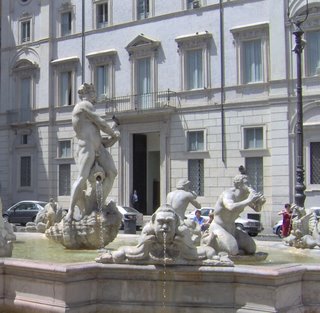
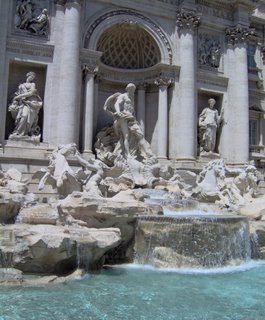
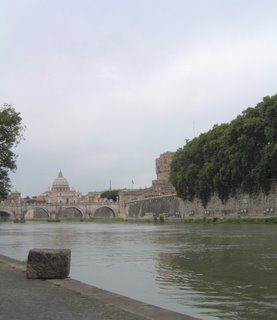
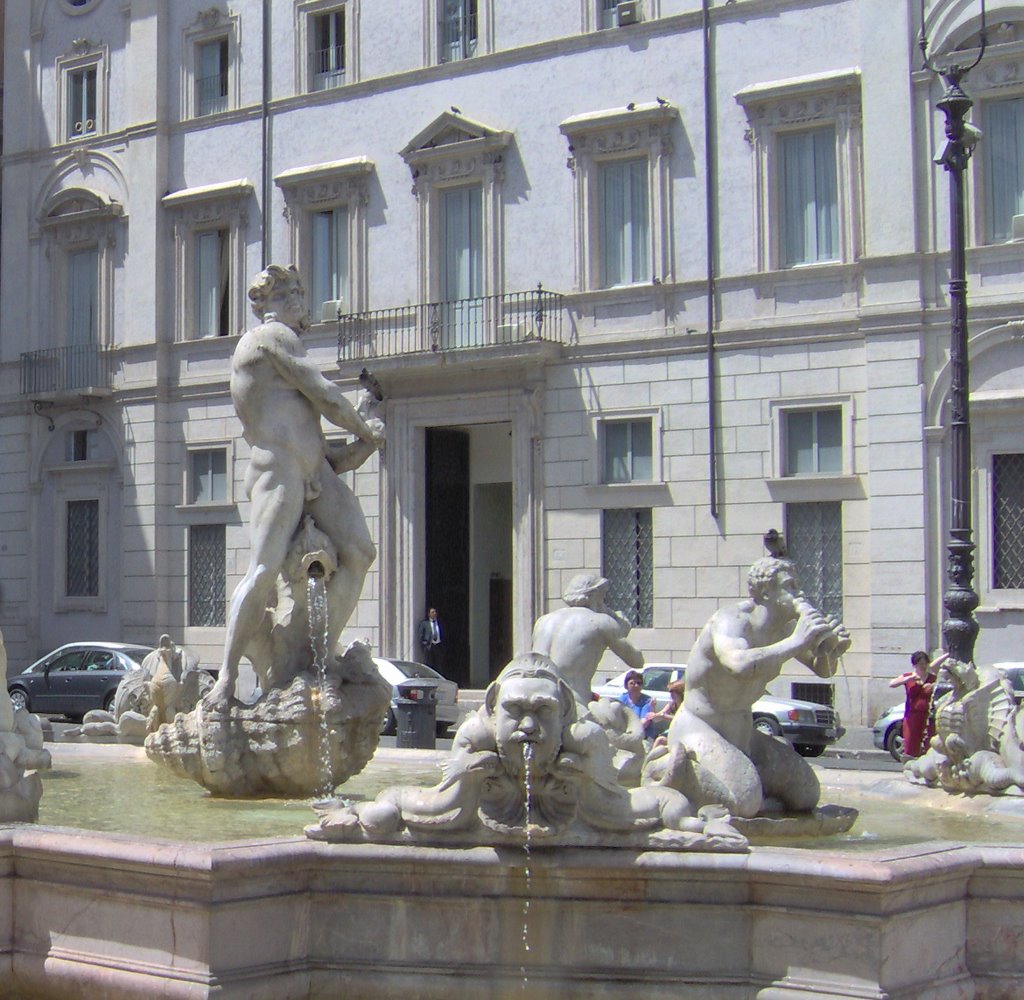
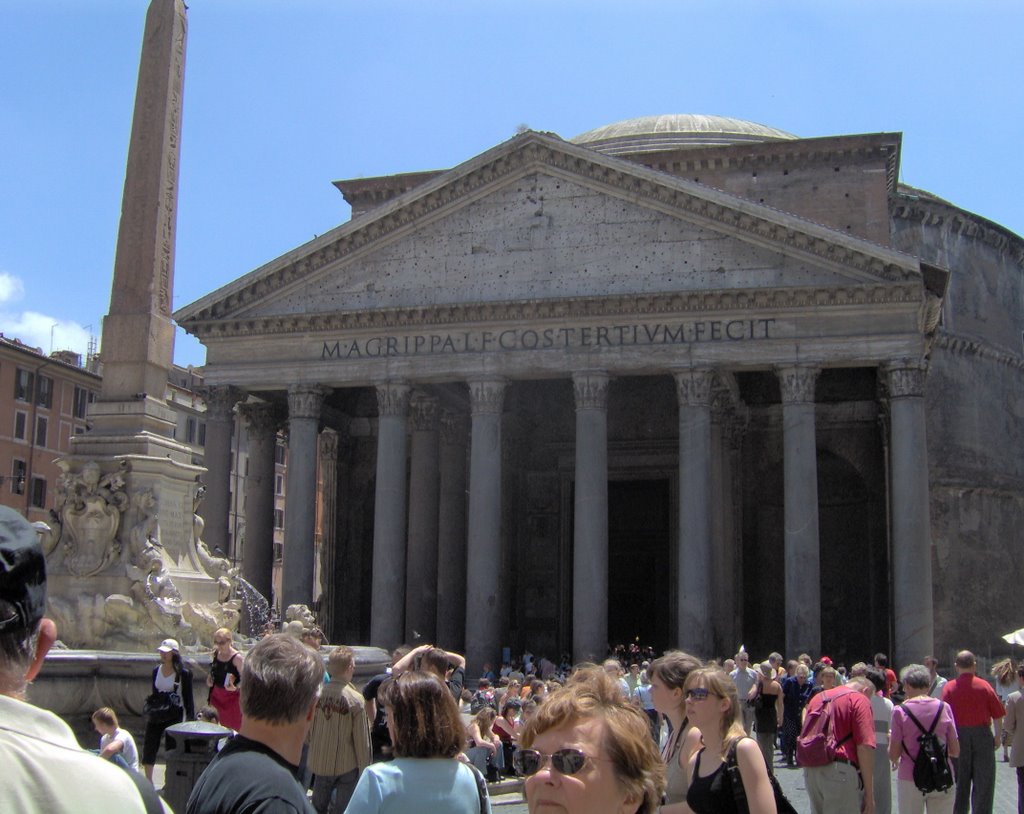
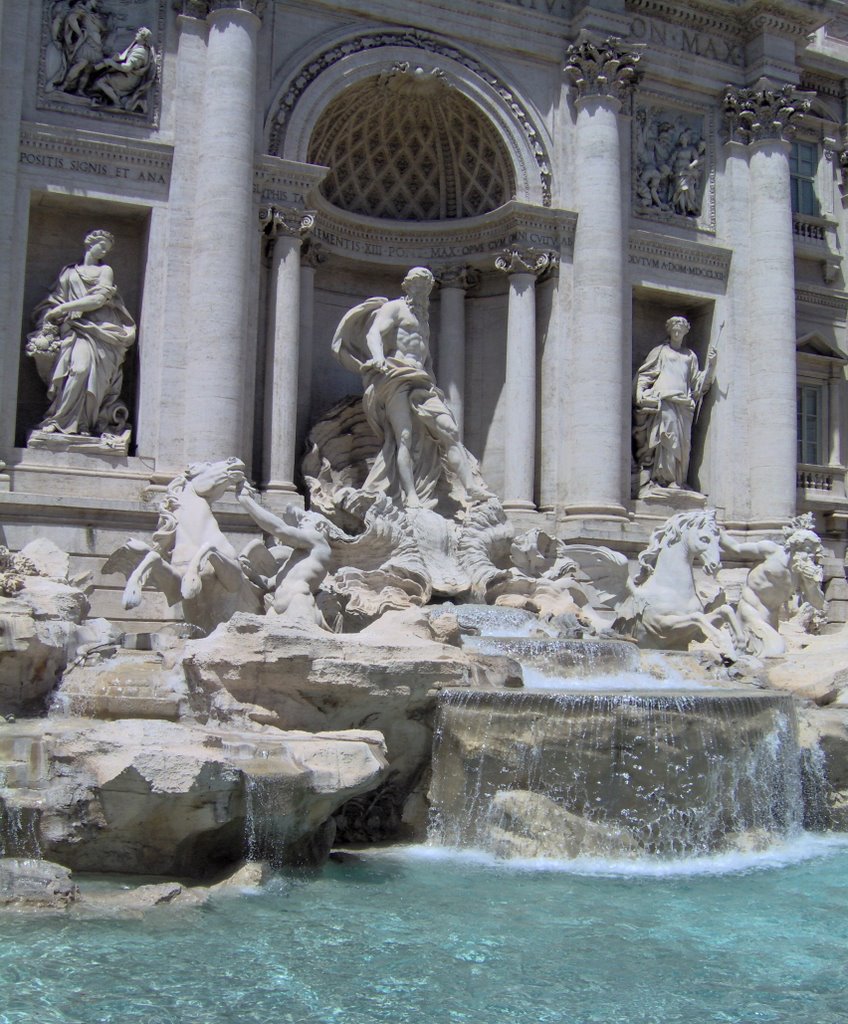
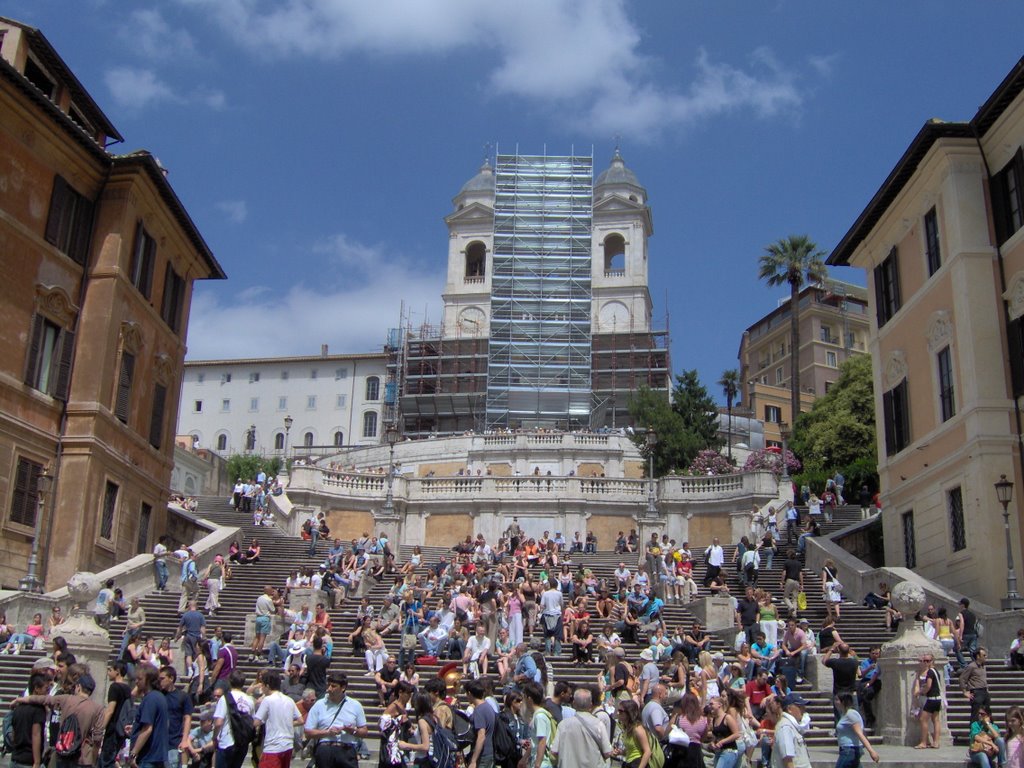
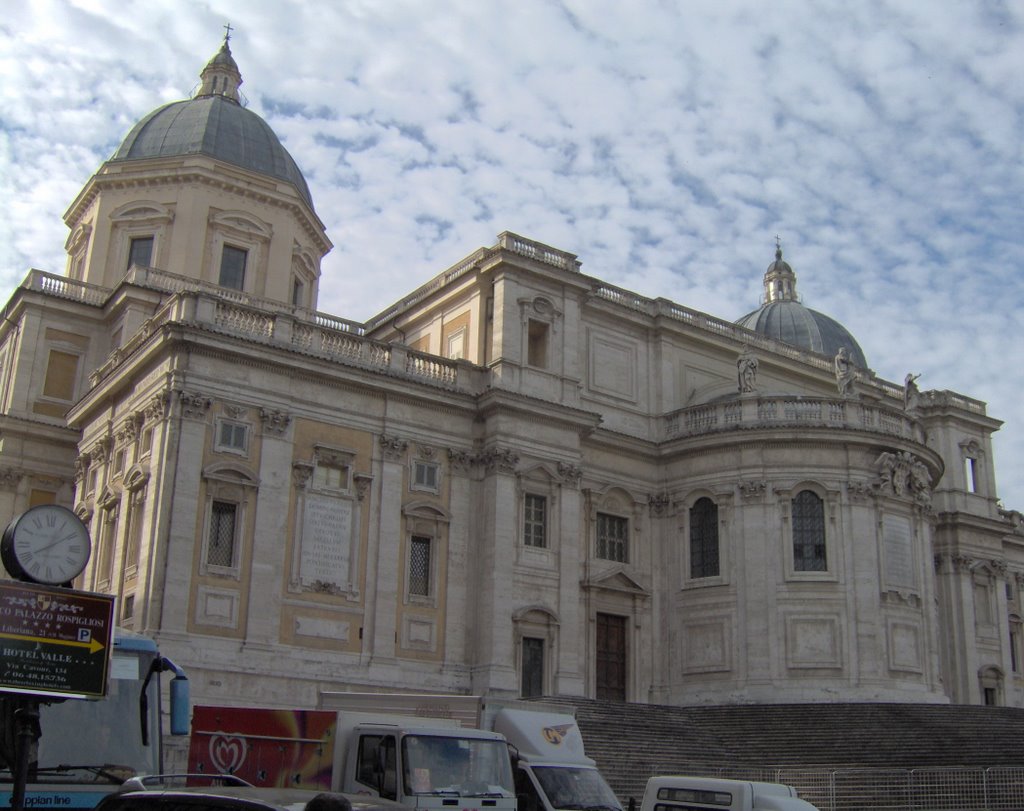
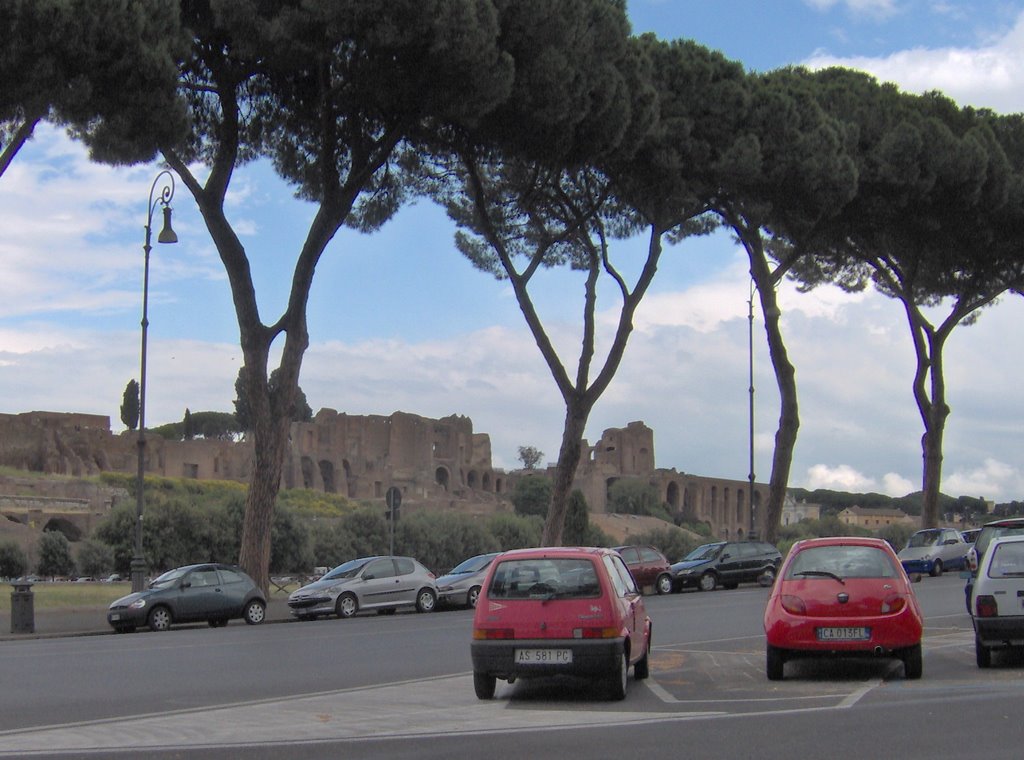
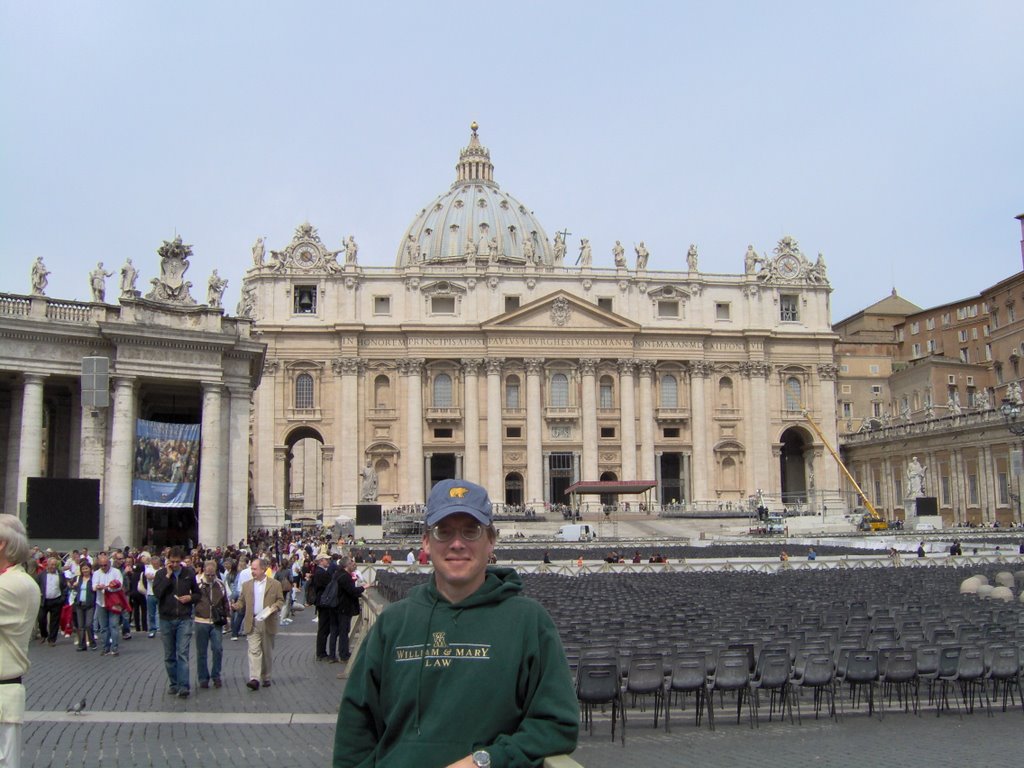
I didn't realize how touristy Florence would be, but I had no illusions about Rome. We stayed another three days in Rome after the end of the Tuscany and Umbria tour and we went to see the most touristy tourist places that we could find. We went to the Pantheon, the Trevi fountain, the Spanish steps, the Vatican museum, Sistine Chapel, St. Peter's, St. John the Lateran and other churches, the market at Campo di Fiori, the site of the Bocca della Verita, the Castel Sant Angelo, some catacombs near the Via Appia, and what was said to be the twenty-some steps Jesus walked up to see Pontius Pilate. We saw the Circus Maximus and even the rose garden across from it. The weather was ok on the first day, blazing hot the second day, and too cold on the third day. We took one afternoon off and lounged by the pool, which was the best feature of the Sheraton Roma. We took a number of heart-stopping cab rides. We saw peace demonstrators and even more police with machine guns, and stood with crowd waiting for some unknown celebrity to exit a government building. The best place we ate was a restaurant called Sabatini in the Piazza di Santa Maria in Trastevere.
Here are some pictures:
Fountain in the Piazza Navona
The Pantheon

The Trevi fountain
The Spanish Steps

Santa Maria Maggiore

Vatican Museum

Santa Maria di Trastevere
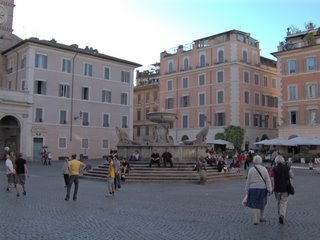
Campo di Fiori

Across the street from the Circus Maximus and the Forum ruins

Inside St. Peter's

Outside St. Peter's
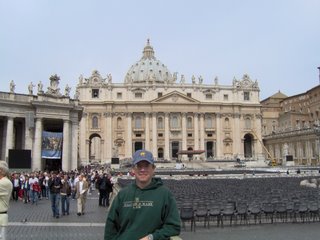
Along the Tiber, looking back at St. Peter's and the Castel Sant Angelo
Last lunch, again in the Piazza Navona

Here are some pictures:
Fountain in the Piazza Navona
The Pantheon
The Trevi fountain
The Spanish Steps
Santa Maria Maggiore
Vatican Museum

Santa Maria di Trastevere

Campo di Fiori

Across the street from the Circus Maximus and the Forum ruins
Inside St. Peter's

Outside St. Peter's
Along the Tiber, looking back at St. Peter's and the Castel Sant Angelo

Last lunch, again in the Piazza Navona

Cortona - Perugia - Spoleto - Assisi
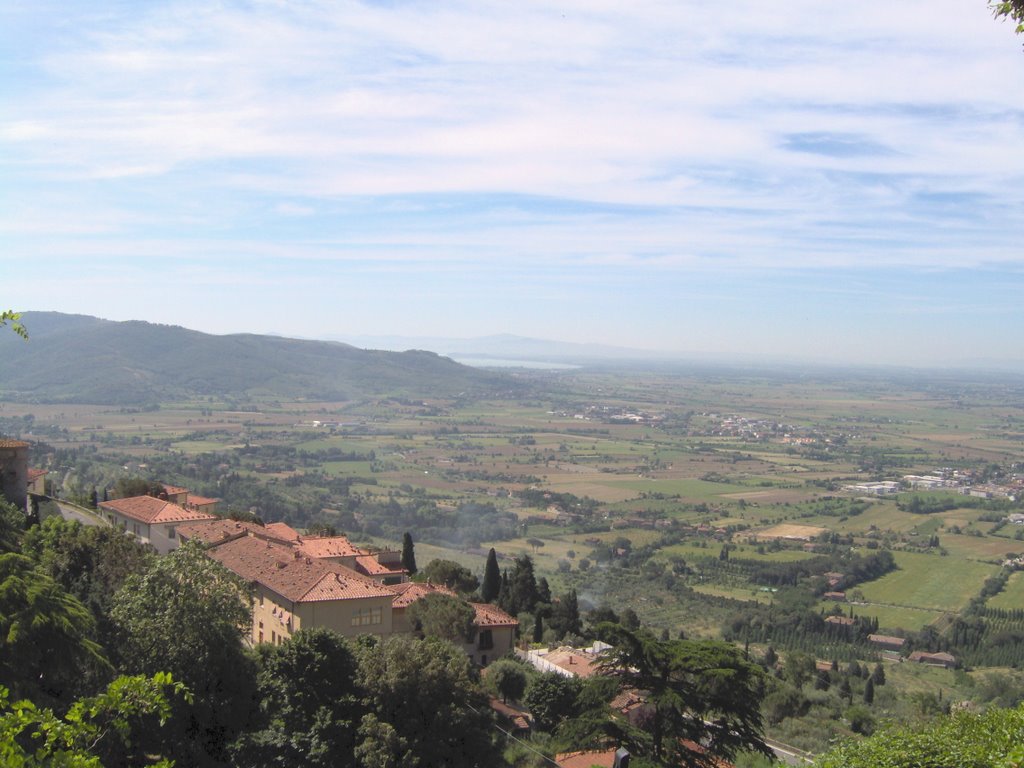 After the mean streets of Florence, our return to the countryside was something of a relief. As the tour progressed, the guide Genevieve did less talking and instead would play music or do something else as we moved from one town to another. She played a video about the Palio as we left Siena. One day she played music from Life is Beautiful, another day Puccini, the last day a medley of Italian folk songs. As we left Florence, however, she read (in English) a couple of stories from the original Pinocchio, which had a tranquilizing effect as we left the city and went back into the country to Cortona. Cortona is lately famous as the setting for Under the Tuscan Sun, the movie and the novel. Looking down into the valley, however, one can see the edge of lake which was the setting for the Battle of Lake Trasimene, fought between the Romans and the Carthaginians in 217 B.C. We arrived in Cortona on a Saturday, which was the market day, and so there was shopping. After a few hours in the town, we down into the valley to a cooking school, where the chef was the mother and the translator was her son. Eating followed the learning, and the food was excellent.
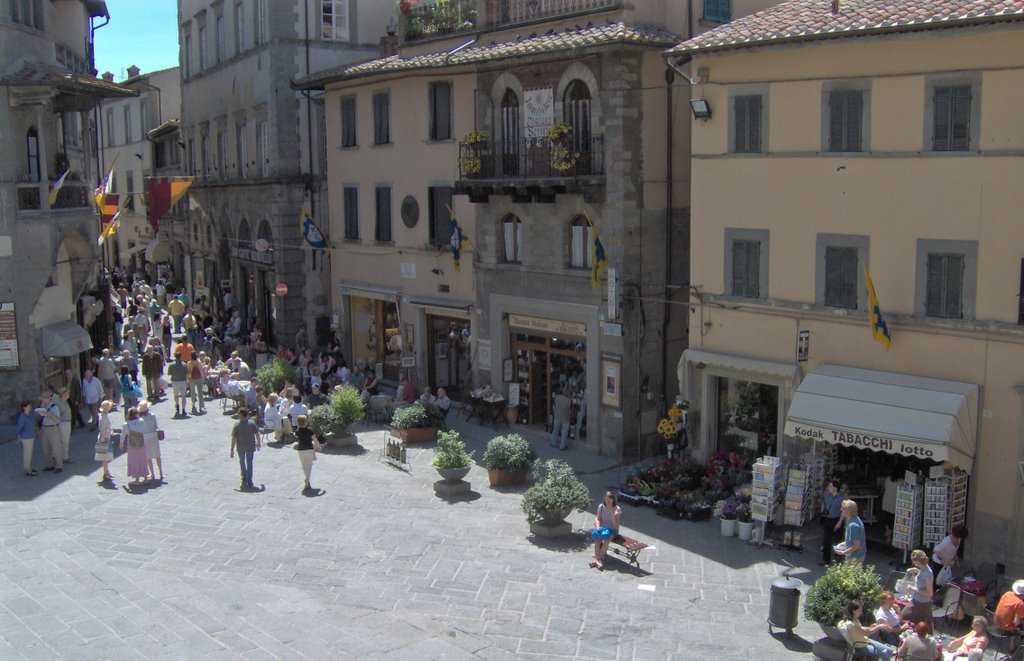 The day in Cortona got only two pages in my travel journal, which indicates primarily that there was nothing but fun. If you check the Wikipedia page for Cortona, you see this picture of an Andre Rieu concert. When we were there, the pace in the Piazza Della Republica was sedate and agreeable. A vendor was selling sandwiches of roast pig, called porchetta. In the food shops, the clerks gave away lots of samples, of olive oil and cheese and wine, and made many sales. Dana bought some black truffle oil. I ate dishes with black truffle at every opportunity while we were in Perugia. The only obvious tourists were the people in our group. There were no cars moving the whole time I was there.
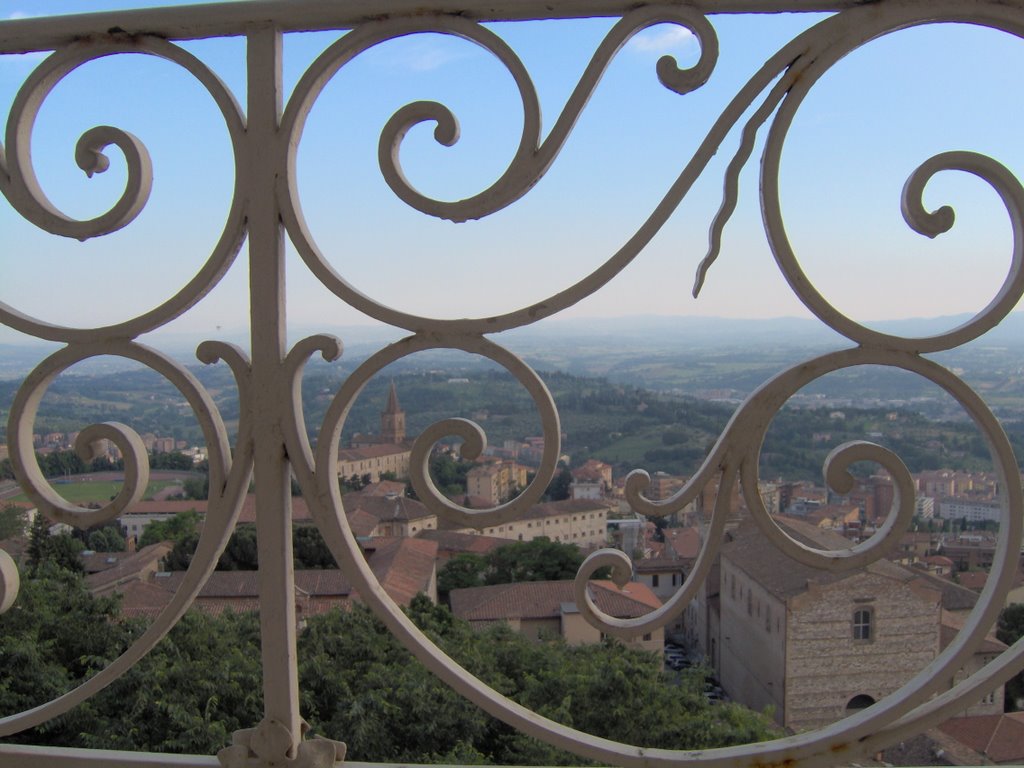 We stayed the next three nights in Perugia, in a room with a little balcony. The hotel in Perugia was the most enjoyable of the places where we stayed, as it had a terrace on the third floor, and we were invited into the kitchen where the chef made chocolate desserts for us. The day after Cortona, we went to Spoleto and Assisi. On the way back from Assisi, we saw an airshow by a group of fighter pilots from the Italian Air Force, the Frecce Tricolori. People were stopped by the road, standing on their cars, standing out in fields, and standing on their houses to see the jets. One fellow was sitting on top of his chimney. The jets flew back and forth over the bus as we inched through the traffic back to Perugia. You can see slides of the May 28 airshow over Perugia here. Later on our last day in Rome on June 2, which was the national holiday celebrating the anniversary of the Republic, we saw the same group pass overhead as we were eating lunch in the Piazza Navona.
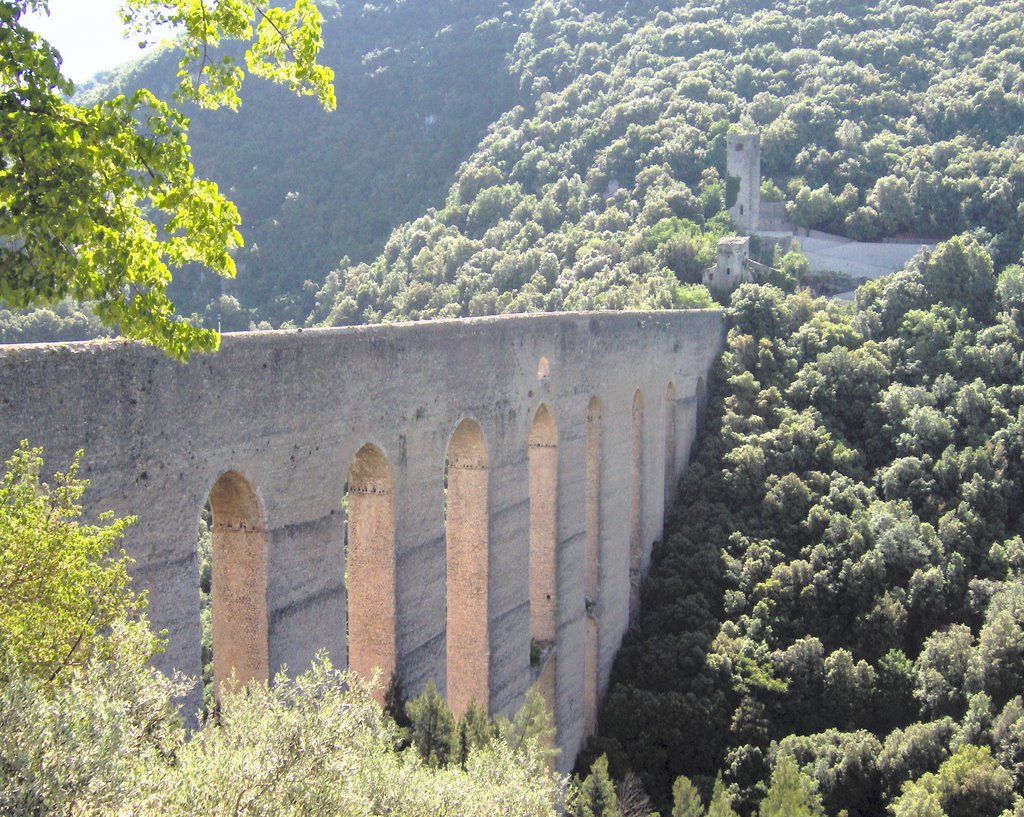 The day after Cortona, we went to Spoleto and Assisi. We entered Spoleto by way of the famous medieval bridge, the Ponte delle Tori, and worked our way down past the cathedral and we were picked up below the town a few hours later. Spoleto has got much more going on than the small towns we visited, but it was Sunday when we were there and so I couldn't guess how much busier it is when everyone is working. The shops were open, nevertheless, and there were many good places to eat. The best pizza we had on the trip, or that which best hit the spot, was in Spoleto. The pizza we had in Italy should have been called something else, as it was quite unlike the pizza I eat in the United States, all of it had a thin and crispy crust and the toppings were more simple and less of them. It was tasty but never dripping with cheese and sauce. And, "pepperoni" does not mean "pepperoni" in Italian. We sometimes had prosciutto on the pizzas but that was the only meat we ordered. Most often we had tomato, cheese, and mushroom pizzas, as simple as it sounds.
 We figured out the menus as we went along. When we got back, the girl across the street asked if we had an Italian phrase book. I laughed and said all the Italian we used would fit on a single page. Always and everywhere I said "grazie" to the waiters (who replied "prego"), "buon giorno" and "bona sera" when I saw members of our group out and about, and "andiamo" we were running late. The whole time, my father-in-law believed that he had mastered the phrase, "il conto, por favor." (Perhaps the waiters thought he was half-Spanish.) The gelato places often had labels in English, but we tried interesting looking flavors based as much on what they looked like as what they were. At some restaurants we ordered pasta or what not based more on the sauce than the noodle - we learned a few ingredients and would order something flavored with what we liked, but there was always some guesswork. The only television I watched for more than a minute in Italian was one of the Naked Gun movies, with Frank Drebbin speaking Italian (and it was the one in which he impersonates Enrico Palazzo). And so it was that I had to ponder the significance of a cafe in Spoleto with the letters "UVA" on the glass - either the place had some connection with the Italian word for "grape" or it was some kind of Wahoo alumni extension office previously unknown to me.
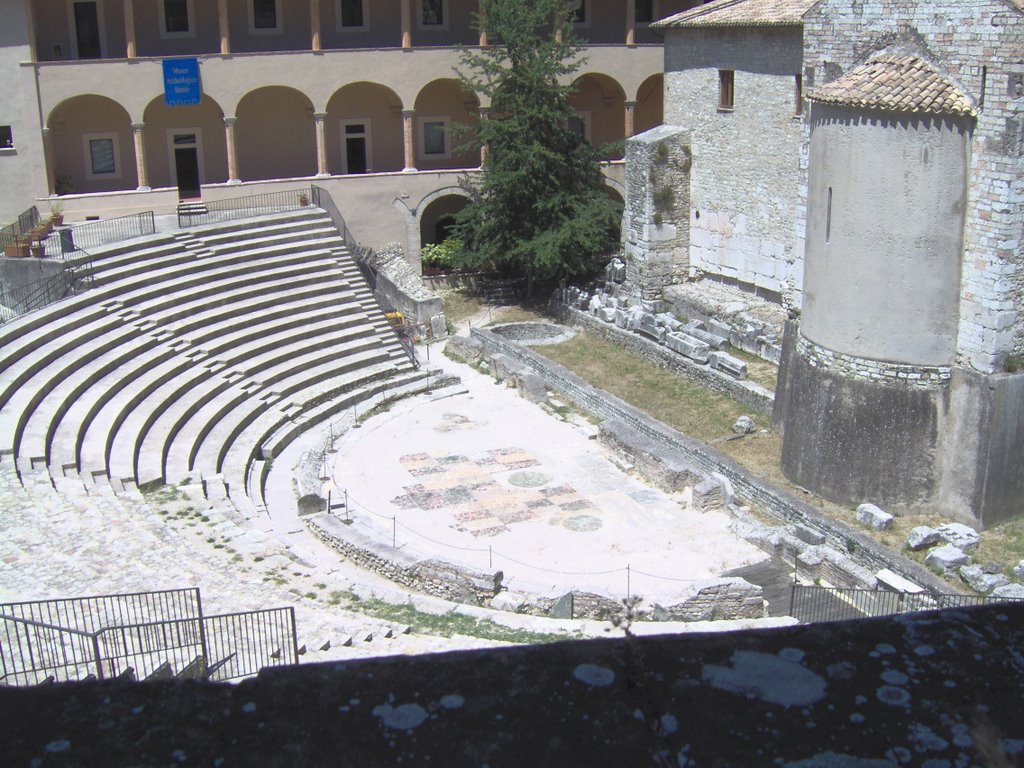 In Spoleto, we snuck a peak at the Roman ampitheatre. Umbria being closer to Rome, were told that it was more greatly influenced by Imperial Rome. In each place we went, the guides tried to say something of the history, including the influence of the Etruscans, the Roman Empire, and in Umbria, the tribe of the Umbri. I was informed, perhaps erroneously, that outdoor performances related to the famous Spoleto festival are held in the ampitheatre and also in the piazza in front of the cathedral. It is hard to imagine this scene. When we went to the cathedral, no one was there. It seemed odd to be touring a church, any church, but we went to many before we were done. The various guides at different points repeated the fact that church attendance is on the wane in Italy. As we were leaving the cathedral, we met a few townspeople on their way in to the 11:00 mass.
 This picture shows what the piazza looked like as we saw it on Sunday morning. There were no crowds in Spoleto. The local guide explained the complicated history of the cathedral and the town. At several points, the local guides in Spoleto and elsewhere were somewhat anti-clerical in their commentary. We were told of the pasta called "strangolapreti," which means something like "priest choker," and the explanation was that the noodles were so thick that only the rich priests could afford them, and the poor people hoped they choked on them. We were told more than once that the Pane Toscano has no salt as a protest against a salt tax imposed by the Church. We were told that the Church retaliated against the towns for their rebellion. The Church was blamed, for example, for the removal of the medieval towers from the towns that tried to break with the Church.
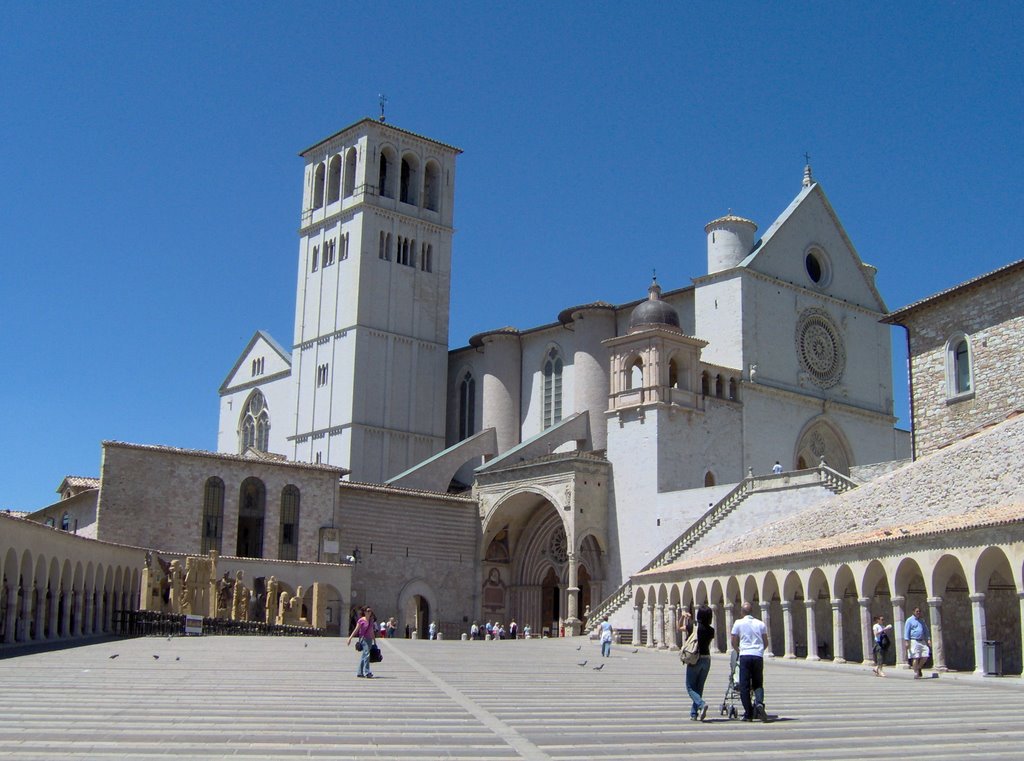 From Spoleto, we went on to Assisi, where we toured the lower church, the upper church, the upper town, and the lower town. Here you can see the lower entrance to the left and the upper entrance to the right. The guide was not allowed to go inside the church, perhaps the Franciscans had heard what he was telling the tourists in Spoleto and Perugia. The church was interesting but dark. In part, the art told the story of the life of St. Francis. The Franciscans were strict on keeping silence in the lower church. The noise was policed by an amplified voice demanding "Silencio!" every few minutes. The story of St. Francis is compelling, the churches were interesting, and the lower town was very nice, so I enjoyed Assisi, even though it was unseasonably hot. Inevitably, many of the small shops we saw in these hilltop towns have their own websites, including this one from Assisi.
 Here you can see a little bit of what the lower part of the town was like, with shops wedged into the buildings but also the view of the valley below. After walking through Spoleto and Assisi, we were tired when we got back to Perugia, and so we ate at a place called La Taverna, which was another good place, even though walking down there did not look promising from up on the main drag. Perugia is by no means a small town but it is not really a tourist town, either, and so we enjoyed it, and it had views in every direction. Our last day of the organized tour required no bus trip as we simply walked out of the hotel and toured a little bit of Perugia. Almost every place we went, we were told told that the town has a symbol or sometimes more than one. In Siena, they claim a connection with the wolf. In Perugia, it was the griffin.
 Here is a view from an outdoor place where we went to sit and cool off after the walking in Spoleto and Assisi. We did a lot of walking also in Perugia, during the three days we were there. The first night the main street was filled with thousands of teenagers. It was Saturday night. We were told that the thing to do in Perugia (and elsewhere) is to take a passeggiata. We generally didn't. We were overwalked and overfed. What walking we did at night was mainly walking back from dinner. The restaurants mainly do not open for dinner until around 7:30, which seemed plenty late. We were told that the midday meal is the main meal for Italians, but no one seems to have shared that information with the people who were selling the food to the Americans at night.
 The historic center of Perugia is sort of hilltop pedestrian mall, where the main items of interest are the town hall, the fountain, and the cathedral. This picture was taken from the steps of the church looking across to the town hall, where you can see griffins above the door. The other most famous fact about Perugia is that it is where Perugina chocolate, or some of it, is made. Perugina is now owned by Nestle, but we were told that all of the Baci are made in Perugia. Perugia is held out as the chocolate capital much in the same way that Hershey, PA, claims to be a chocolate capital. We were told that the original name for the Baci was "The Knuckle" but some sharp marketer concluded that a better name would be "The Kiss." (I bought a small sack of the little ones for the people at the office, the cheapskate that I am.)
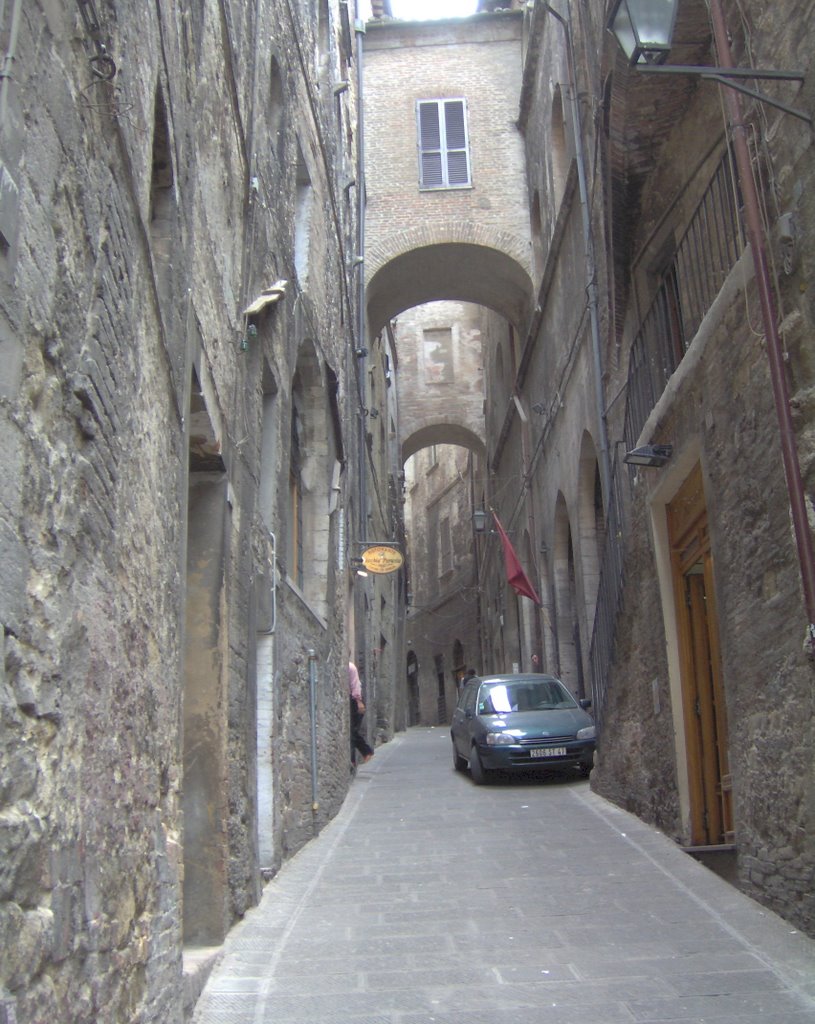 On the last day, we wandered off the top of the hill into some of the alleys and backstreets. I'm not exactly sure where we went, but we took many pictures before choosing this promising "street" as our route back to the places we knew. We shuffled back to the hotel for the farewell dinner with the tour group. The next day we were back in Rome.
Friday, June 16, 2006
Siena - Florence
 We went to Siena, and it rained, which made the morning kind of downer, after the excellence of the previous day. The cathedral in Siena is quite a spectacle, but since the outside was mainly covered with scaffolding, the best pictures were taken inside. In particular, there was one room which we were told had been closed off for hundreds of years, and so the walls and the ceilings looked as though they were newly painted. And, it was true. We saw lots of fancy walls and ceilings, but none fancier than that library or whatever it was in the cathedral there in Siena.
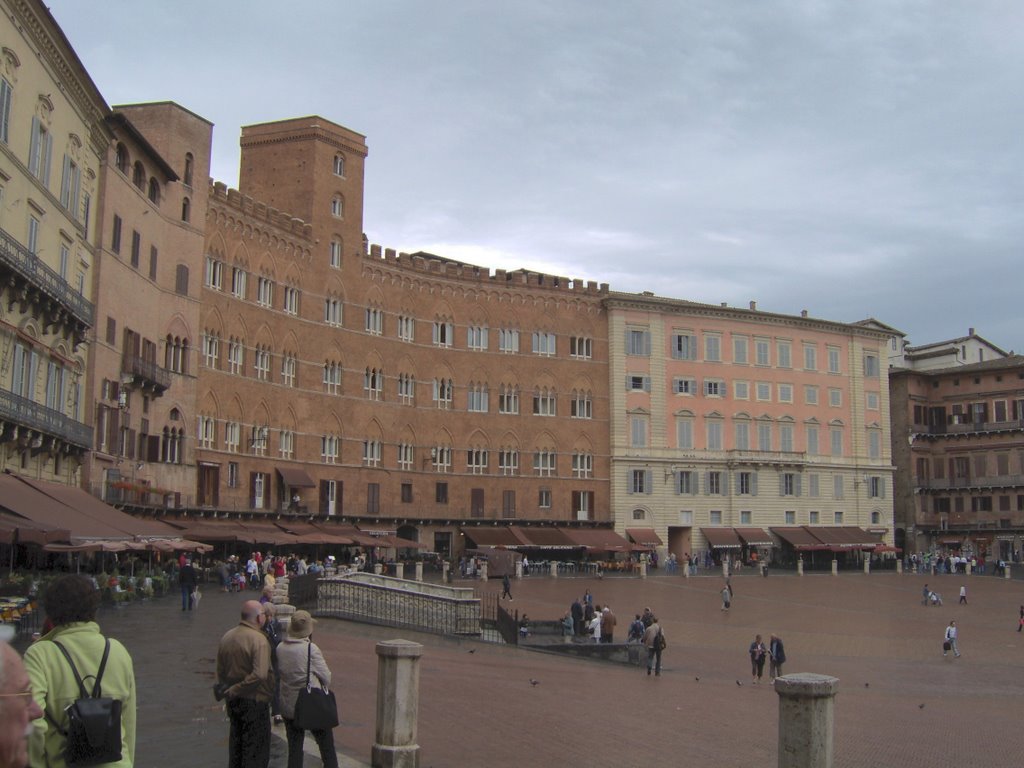 Also, in Siena, we were told about the Palio, which is sort of like if the Hatfields and the McCoys had a horse race in the middle of town every year, only there are a bunch of different clans, called the contrade. When we were there, since it was rainy, the Piazza di Campo where the big horse race is held was mostly empty, except for pedestrians passing across, and it was difficult to imagine it hosting 50,000 Siennese for a horse race.
 Here is a McDonalds in Siena. I had to go inside and see what was the price of an Big Mac extra value meal, and it appeared that the price was about six Euros, but I'm not sure whether that included the drink. Cokes were expensive, the .75 liter bottles cost between 2 and 3.50 Euros. We also drank a lot of bottled water, bottled water at every meal, usually frizzante (with bubbles). I don't know what it cost. A big gelato with three flavors cost 3.50 Euros, most places. The best gelato was probably in Florence, which is where we went next after Siena.
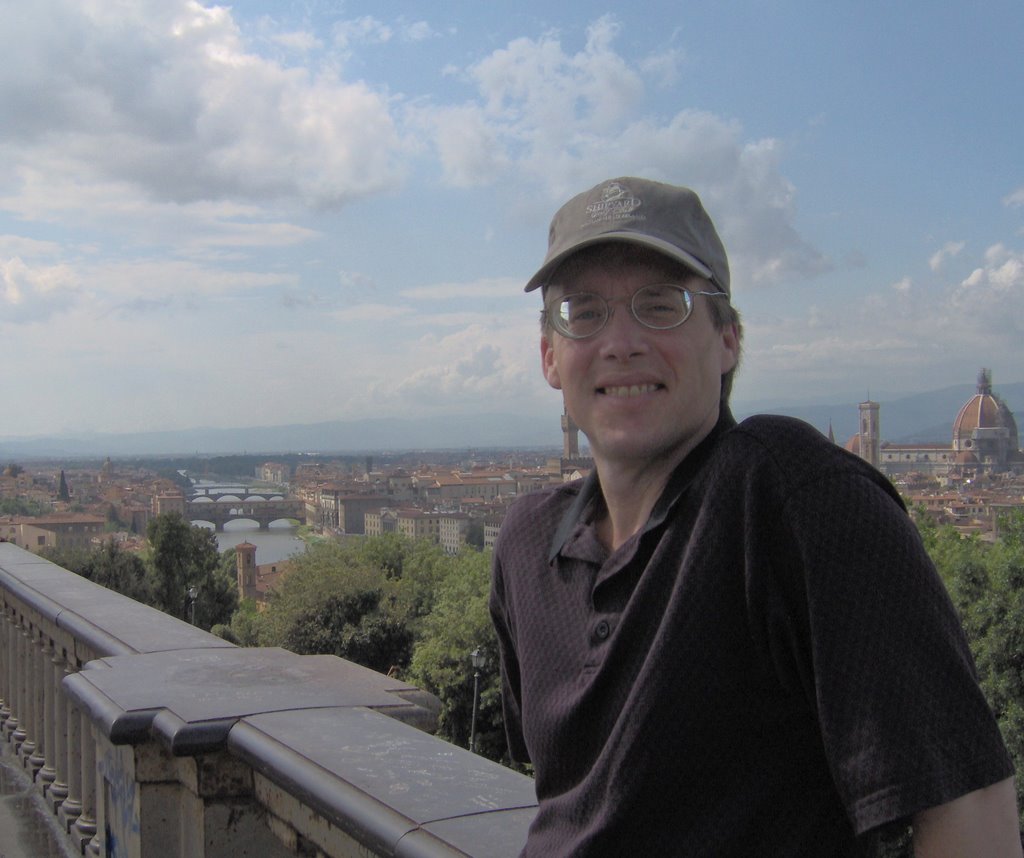 Florence was full of tourists, and full of interesting things to see. The first thing we did was go up to this overlook place, and everyone took too many pictures. You can see behind me on the left the Ponte Vecchio crossing the Arno River, and on the other side the dome of the Duomo. Florence is small enough to walk everywhere and it is hard to get lost because you can see the Duomo from almost everywhere. We didn't get very far from the middle of town, we went to one restaurant across the Arno overlooking the river, we went to the Uffizi which was just around the corner from our hotel, we went to the Academy to see the David (although there were Davids everywhere, it seemed), we went to market at San Lorenzo, we looked in the street markets everywhere, and twice we ate at this place called Leo's, a great place.
One day at breakfast in Florence, I said, "Look, we've got salt and pepper." They don't give away salt and pepper in restaurants in Italy as in the U.S. Regarding salt, we were told more than once that various towns had a tradition of unsalted bread, as sort of a tax protest going back to medieval times, when the Church imposed a tax on salt. The hotel where we stayed was sort of an odd place. The elevator had a button marked 3/4, which was where you got off for both the third and fourth floors. Most of the hotels had some kind of electricity conversation measure in place. In the more modern places, you had to insert your card key into a slot in the room to get the lights to come. In the Hotel Bernini, the lights came on and went off as you walked down the hall.
 The hotel was a block from the Piazza Signorina. Florence was sort of like Gatlinburg, with all the shopping, but with fancy buildings and lots of really big nude sculptures in the squares. One exception was the statue of Cosimo of the Medicis, who was dressed and sitting on a horse. Also in the Piazza Signorina there was a wreath on the spot where Savonarola himself was burned. The Ponte Vecchio was full of jewelry shops. In this picture I am standing in the middle of the bridge, looking back toward the Duomo, and there was shopping and people everywhere. The only thing I bought of interest in Florence was four neckties for the total sum of 18 Euros.
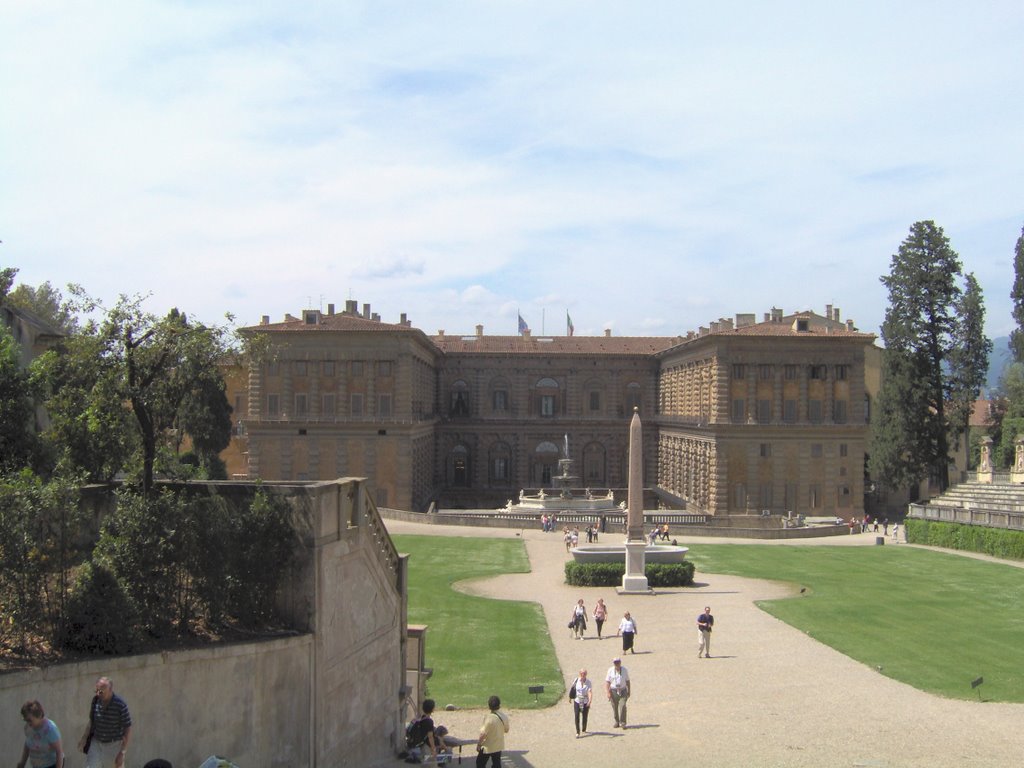 One thing we did to get away from it all just a bit was to go to the Boboli Gardens, across the Arno and behind the Pitti Palace. I think the admission to the Boboli Gardens was about 8 Euros. The gardens were interesting and presented more great views of the city. The only bad part about it was that a lot of the walking we did was uphill. You can see the in-laws are still a ways down the hill in this picture, looking back down at the back of the palace.
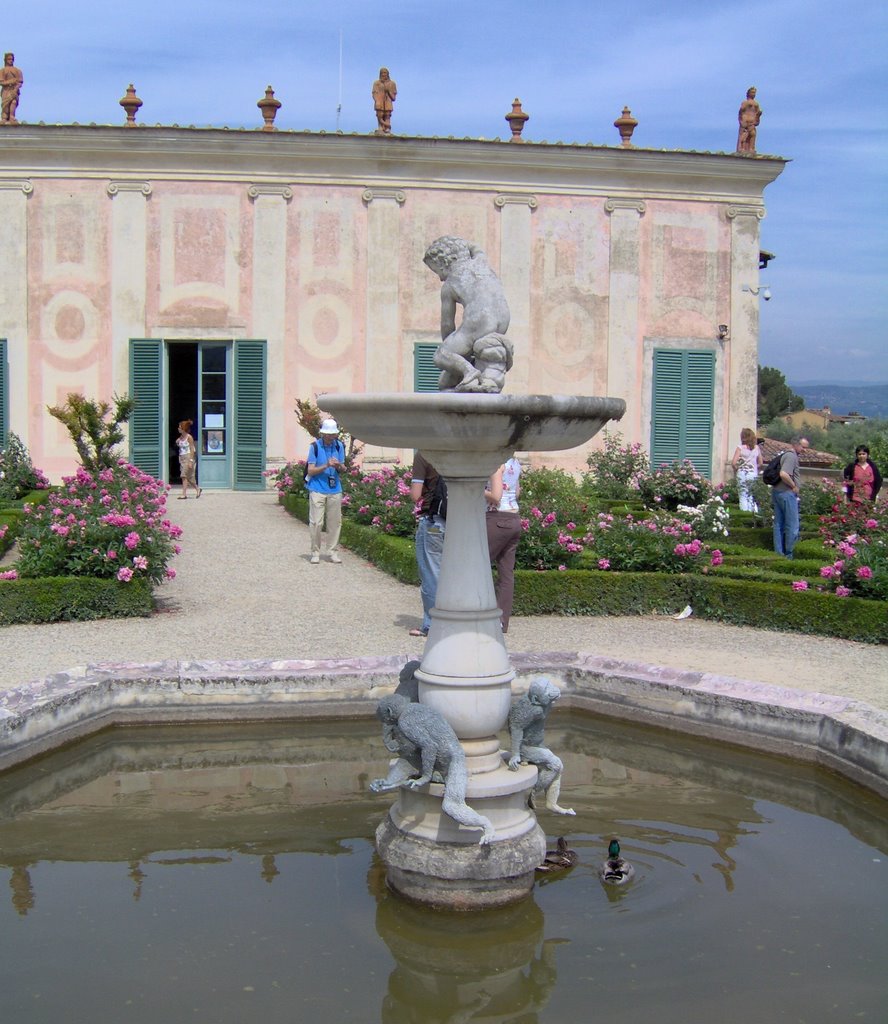 At the top was a rooftop garden full of roses and peonies. In the middle of the rooftop garden was the fountain with monkeys. I have no idea what that's about, but I took pictures of it all from every angle, probably 50 pictures. The only other bad thing about the Boboli Gardens is that we never found a decent map, so we only saw whatever we stumbled onto, which wasn't all bad. There were many unexpected sights besides the fountain of monkeys. We didn't figure out until we were leaving that we had only seen maybe a third of the place.
 But on the way out, we did see the Grotto, which I can't begin to explain, and enjoyed the views back across the river of the city.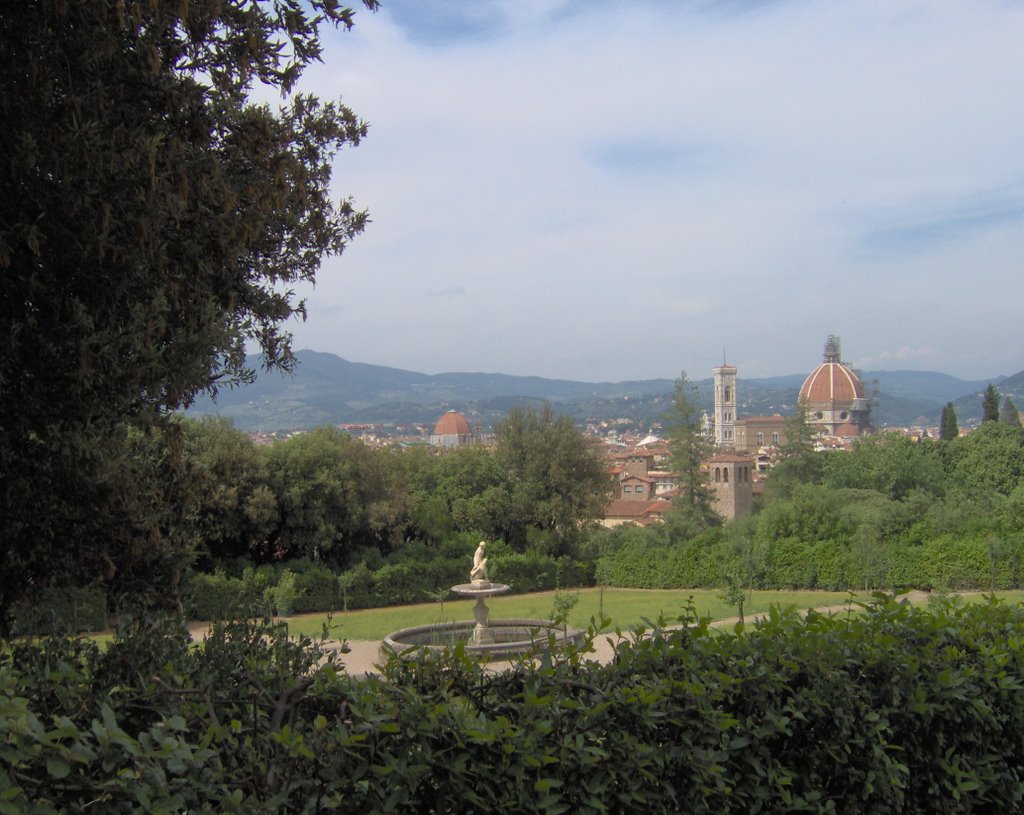
We didn't go in any of the churches in Florence, but the churches and the towers and the piazzas pretty defined the map of the place, as in "You don't want to go back there, it's all the way on the other side of the Duomo," or "Look, we're almost there, that's Santa Croce up ahead." So, of course I took pictures of them. I could never got more than a bit of the Duomo in the pictures taken from the streets.

Finally, here is a sunset picture of Santa Croce.

Why you don't ever want to take the judge's parking space
The Memphis paper reports here that somebody vandalized the cars of judges parked at the Peabody Hotel for the summer meeting of the Tennessee Bar Association.
On historical markers in Virginia
This great article in the Hook on those historical markers on Virginia's highways has a link to this site which details 1,209 markers in Virginia - but not Southwest Virginia, apparently.
Remarks of President Bush on signing the MINER Act of 2006
Wednesday, June 14, 2006
Gospel according to Ernie
Ernie Svenson offers a how-to on Organizing Cases Electronically.
He and Ray Ward seem to me pretty sane for having survived Katrina, etc., not so many months ago. Those New Orleans lawyers have tested all their systems in ways the rest of us never will.
He and Ray Ward seem to me pretty sane for having survived Katrina, etc., not so many months ago. Those New Orleans lawyers have tested all their systems in ways the rest of us never will.
Lawrence-based challenge to Virginia's sodomy laws overruled
In McDonald v. Com., the Virginia Court of Appeals in an opinion by Judge Haley, joined by Judge Clements and Senior Judge Overton, reject once again a constitutional challenge to Virginia's criminal statute outlawing sodomy, where the defendant relied on the Supreme Court's decision in Lawrence v. Texas, but the crime involved someone under the age of 18, which made Lawrence distinguishable.
This opinion brings to mind two points: (1) I read a Slate article the other day by Dahlia Lithwick about how Justice Kennedy drives conservatives insane, speaking of Lawrence; and (2) a while back the point was made to me that the Virginia Court of Appeals in its cases observes a wide variety of human behavior, which also seems to be true.
Howard Bashman has a link here.
This opinion brings to mind two points: (1) I read a Slate article the other day by Dahlia Lithwick about how Justice Kennedy drives conservatives insane, speaking of Lawrence; and (2) a while back the point was made to me that the Virginia Court of Appeals in its cases observes a wide variety of human behavior, which also seems to be true.
Howard Bashman has a link here.
Who wouldn't want to come to the VBA summer meeting?
Read all about the summer meeting of the Virginia Bar Association here.
It's got Allen v. Webb.
It's got Governor Kaine.
It's got John Marshall and Thomas Jefferson.
It's got CLE with updates on Virginia courts in the (not-so distant) past and the (not-so distant) future, what do after litigation starts and before litigation begins, matters civil and criminal, laws foreign (OK, international) and domestic (as in domestic relations).
It's at the Homestead.
I'll be there, why not you?
It's got Allen v. Webb.
It's got Governor Kaine.
It's got John Marshall and Thomas Jefferson.
It's got CLE with updates on Virginia courts in the (not-so distant) past and the (not-so distant) future, what do after litigation starts and before litigation begins, matters civil and criminal, laws foreign (OK, international) and domestic (as in domestic relations).
It's at the Homestead.
I'll be there, why not you?
Tuesday, June 13, 2006
This week's CCCC
We were picked as the winner of this week's Commonwealth Conservative Caption Contest.
This week's nonsense pertained to Will V., our last winner was about Hillary Clinton, so at least they have that much in common.
This week's nonsense pertained to Will V., our last winner was about Hillary Clinton, so at least they have that much in common.
Texas hearsay
I loved this post, which said in part:
Steve was attempting to get into evidence a document when I objected because of hearsay. Steve pronounced boldly (and probably rightly) that this was not hearsay because it was not offered for the truth of the matter asserted. Immediately after saying this the J.P. scolded Steve and stated:
"listen here mister...in my court you may only introduce matters which are the truth and you better not be trying to introduce matters which are not for the truth of the matter asserted."
Steve was attempting to get into evidence a document when I objected because of hearsay. Steve pronounced boldly (and probably rightly) that this was not hearsay because it was not offered for the truth of the matter asserted. Immediately after saying this the J.P. scolded Steve and stated:
"listen here mister...in my court you may only introduce matters which are the truth and you better not be trying to introduce matters which are not for the truth of the matter asserted."
Monday, June 12, 2006
On lawyers looking to get paid
I'm told that justice was done in last week's decision by the Virginia Supreme Court in the case of Randall A. Eads v. David Clark, Guardian of the Person and Estate of Roy Dallas Johnson, Incompetent, et al, on appeal from the Circuit Court of Russell County.
It could be true. The facts brought to mind the case from Bleak House, in which Dickens wrote:
"Equity sends questions to law, law sends questions back to equity; law finds it can't do this, equity finds it can't do that; neither can so much as say it can't do anything, without this solicitor instructing and this counsel appearing for A, and that solicitor instructing and that counsel appearing for B; and so on through the whole alphabet, like the history of the apple pie. And thus, through years and years, and lives and lives, everything goes on, constantly beginning over and over again, and nothing ever ends. And we can't get out of the suit on any terms, for we are made parties to it, and MUST BE parties to it, whether we like it or not."
It could be true. The facts brought to mind the case from Bleak House, in which Dickens wrote:
"Equity sends questions to law, law sends questions back to equity; law finds it can't do this, equity finds it can't do that; neither can so much as say it can't do anything, without this solicitor instructing and this counsel appearing for A, and that solicitor instructing and that counsel appearing for B; and so on through the whole alphabet, like the history of the apple pie. And thus, through years and years, and lives and lives, everything goes on, constantly beginning over and over again, and nothing ever ends. And we can't get out of the suit on any terms, for we are made parties to it, and MUST BE parties to it, whether we like it or not."
It's official - throw your hands in the air and wave them around
From the website of the Appalachian School of Law:
"We are very pleased to announce that Appalachian School of Law was granted full accreditation by the American Bar Association on June 12, 2006."
"We are very pleased to announce that Appalachian School of Law was granted full accreditation by the American Bar Association on June 12, 2006."
Sunday, June 11, 2006
Rome - Pienza - San Gimignano
 Reviewing the photographs from our recent trip to Italy may take twice as long as the trip itself. I took hundreds of photographs, which gave me something to do, but there are few or no photographs of many of the best parts of the trip.
We drove from Abingdon to Richmond, got up early and flew to Newark and then on to Rome. Supposedly, one should sleep on the plane crossing the Atlantic. We didn't. I watched 5 and three-quarters movies during the two transatlantic flights. (I still don't know what happened at the end of Narnia.)
As we were waiting for the first of many bus rides at the airport, another bus full of what appeared to be Italia soccer fans came by, a bunch of beer drinkers and cigarette smokers jumped out, and they began singing. One song was the Ya-Ya-Ya song, of which the only discernible lyrics were "YA-YA-YA."
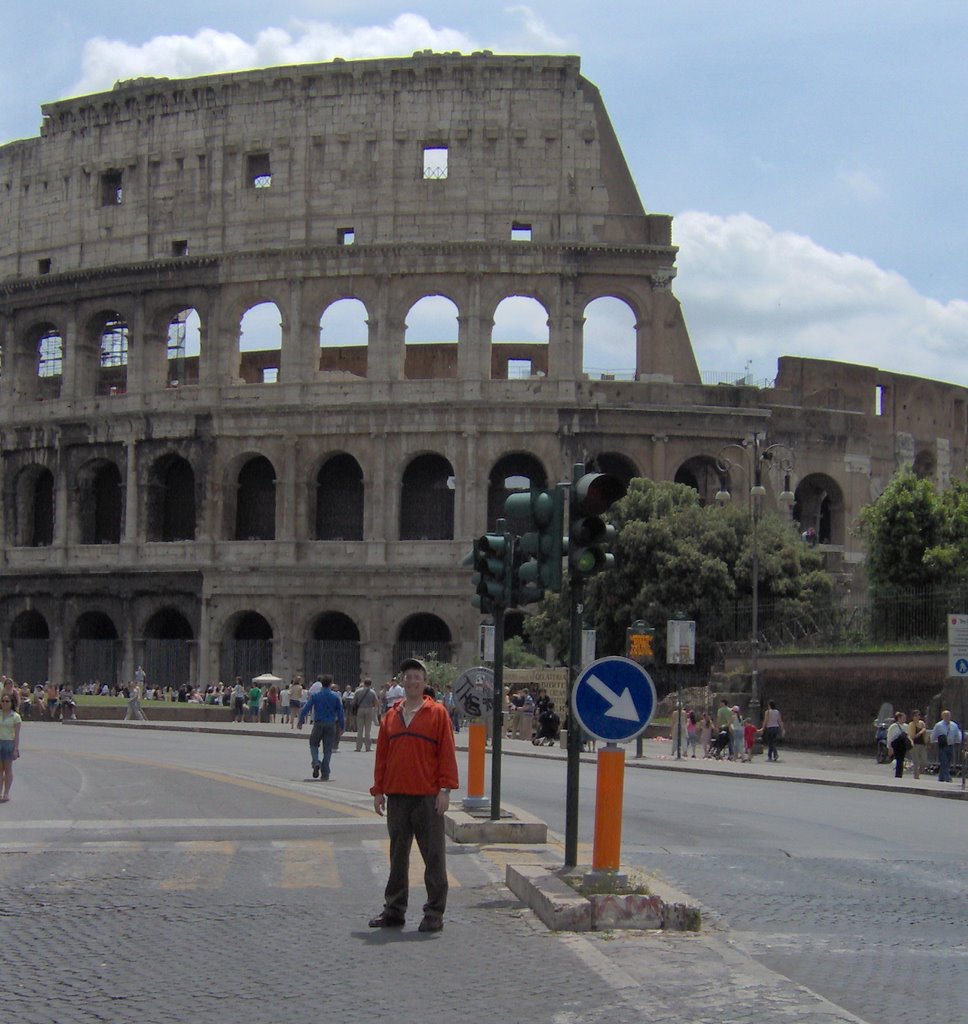
Plan B for travelers is to sleep once you get to Europe, but we didn't do that, either. In fact, we had no rooms, because it was 9:00 in the morning when we reached the hotel, so we took off for downtown Rome. And, we did go see the Colosseum.
There were many wild characters outside the Colosseum, mime, musicians, and one fellow who appeared to be the Gladiator from Chad's Caption Contest, and others like him, whose job it was to have their pictures taken with tourists. We saw another Gladiator between the Arch of Constantine and the Forum whose job was to have his picture taken while groping the teenaged, female tourists.
 We slogged our way in the heat through the Forum to our first Roman street food. I would say that the street food in Rome is mostly lousy except for the gelato which was good everywhere. I tried about 15 different flavors of gelato over the course of 12 days, the weirdest being rose and kiwi and melon.
The next day we joined the Tuscany and Umbria tour, and the first stop was a rest area along the Autostrada. The weirdest thing there was a place where you could stash your dog for a few hours, sort of self-serve rent-a-kennel. The first real food we ate was at the Falco Ristorante in the first of many hilltop towns, called Pienza. That first lunch in Pienza set the tone for the rest of the trip - good plain food and lots of it. They kept bringing us food and we ate it. That was true in Pienza, in Monteriggioni, in Florence, in Cortona, and later in Rome.
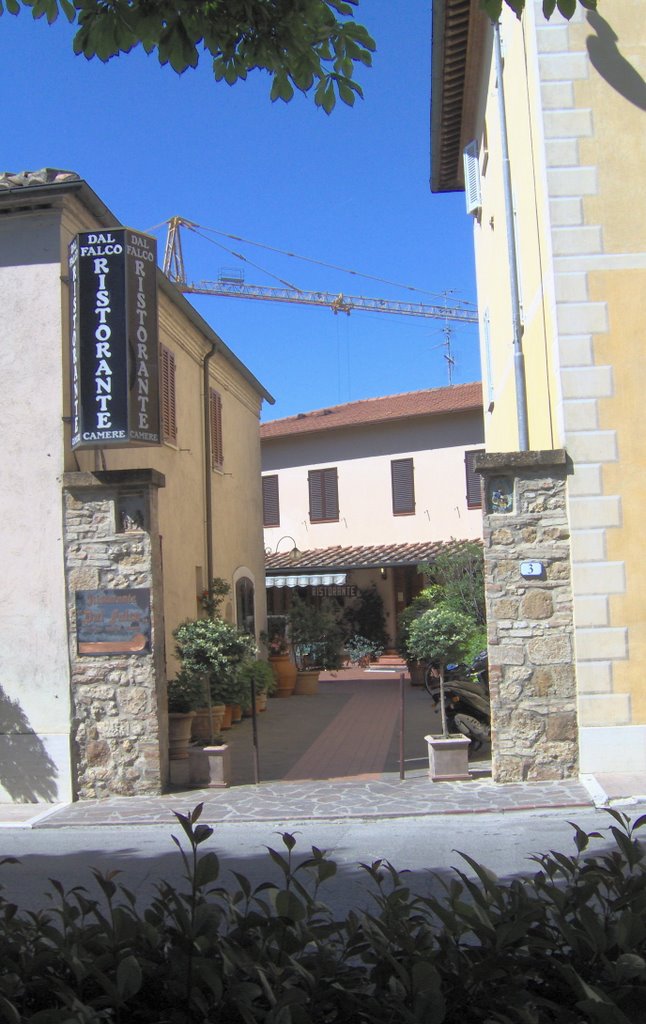 After lunch, we had the run of the town, which is also what we did throughout the tour, scramble over these small towns with narrow streets, small piazzas, crumbling buildings, and great views of the surrounding countryside. We were told as we went into Pienza that Tuscany is sheep country and we would be able to smell the peccorino cheese in the streets, which was true in Pienza and elsewhere. I can't say that we ate a lot of Peccorino cheese or that I am sure when we were eating it, because it comes in many forms, so in some places the restaurants served grated Peccorino for sprinkling on some of the food. I ate pasta almost every lunch and dinner for 12 days, which could explain the width and breadth of my appearance in some of these photographs.
 I was traveling with my wife and her parents and her sister and her sister's husband. Some of our fellow travellers were impressed that we all got along with each other, which I would not have thought to be a remarkable fact. One necessity for keeping the peace was having patience with the shoppers. Some of the shops like this one at the end of the lower lane in Pienza looked more like a hole-in-the-wall than a place to buy things.
 Dana's dad is a retired dentist. In this photo from Pienza, it appears that he has brought with him an over-sized instrument from his old office.
We went on from Pienza to the hotel Il Piccolo Castello. This was a very strange building, the likes of which I had not seen before. It was of fairly recent construction, modeled after the architecture of the Middle Ages. And so, the rooms had ceilings with wood beams and very little light and not much in the way of places to stash your stuff.
At the hotel we began to learn more of our fellow travellers. Remarkably, one fellow was named Frank Sinatra and another George Harrison, fine fellows both.
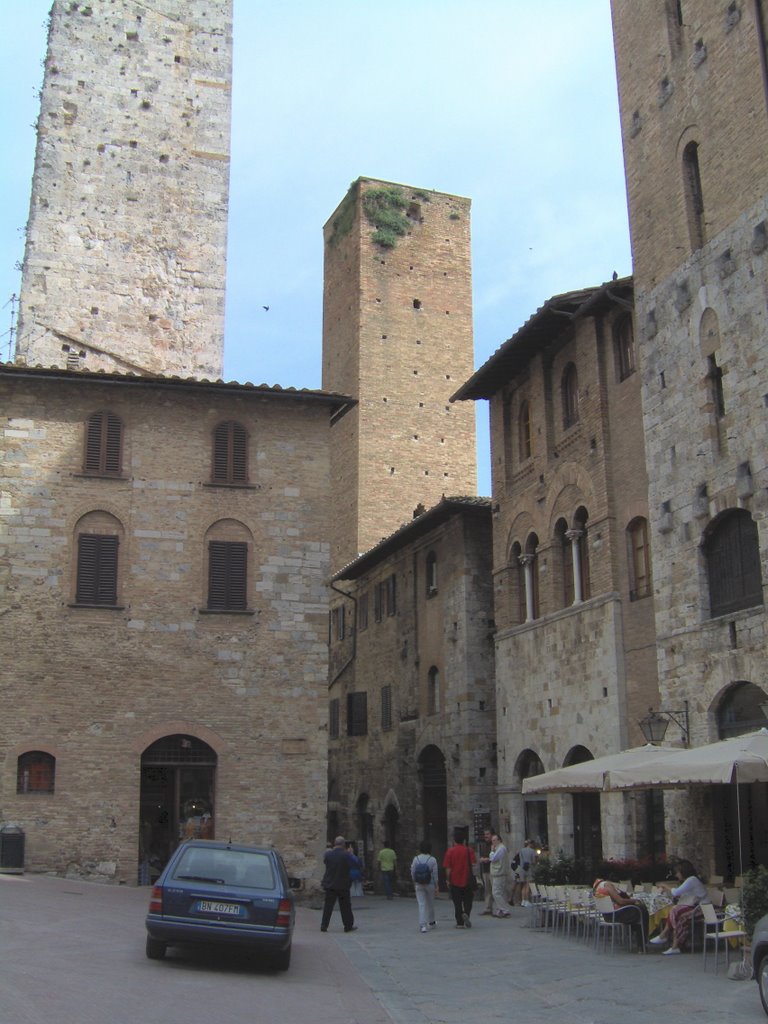 The next day was probably the best day, even though the weather seemed questionable as we left for San Gimignano. The remarkable thing about San Gimignano are the towers, of which there are still something like 18 or 20 and there used to be many more.
Tourists can walk up in at least one of them, and by my count, the number of steps was approximately 190. There might have been more, but I ran out of breath and quit counting. The brother-in-law Dave Brooks and I went up to the top and I took too many pictures of the town and the view in every direction. On the way down, after we had gone down about 15 steps, Dave said to the people we met coming up the stairs, "Don't worry, you're halfway there."
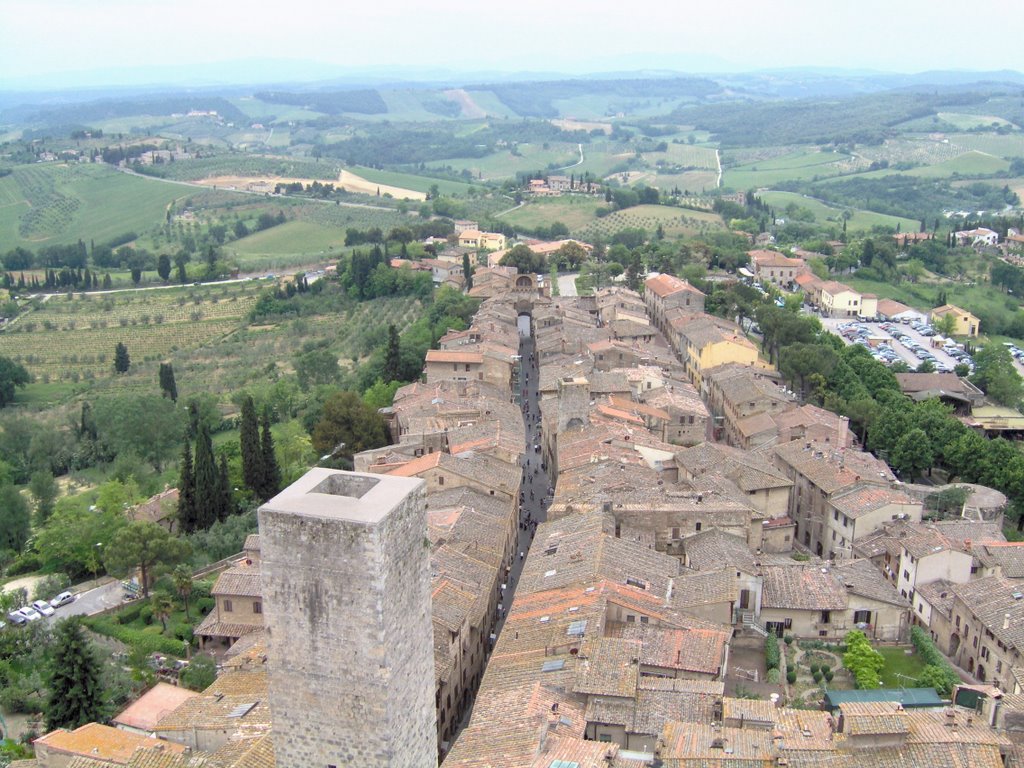 From above, you can see how narrow is the main drag through the town, and how small is the old town. Indeed, Dana and I walked to the end of the main street and began wandering the alleys and at one point wandered through the fence out of the town, which seemed like a bad idea.
In San Gimignano, we ate and spent money and eventually went back to the hotel, where the next big activity was a bike ride through a stretch of the surrounding countryside. I haven't been on bike for some years, certainly not since we moved from downtown Abingdon, but I went and it was tiring but fun.
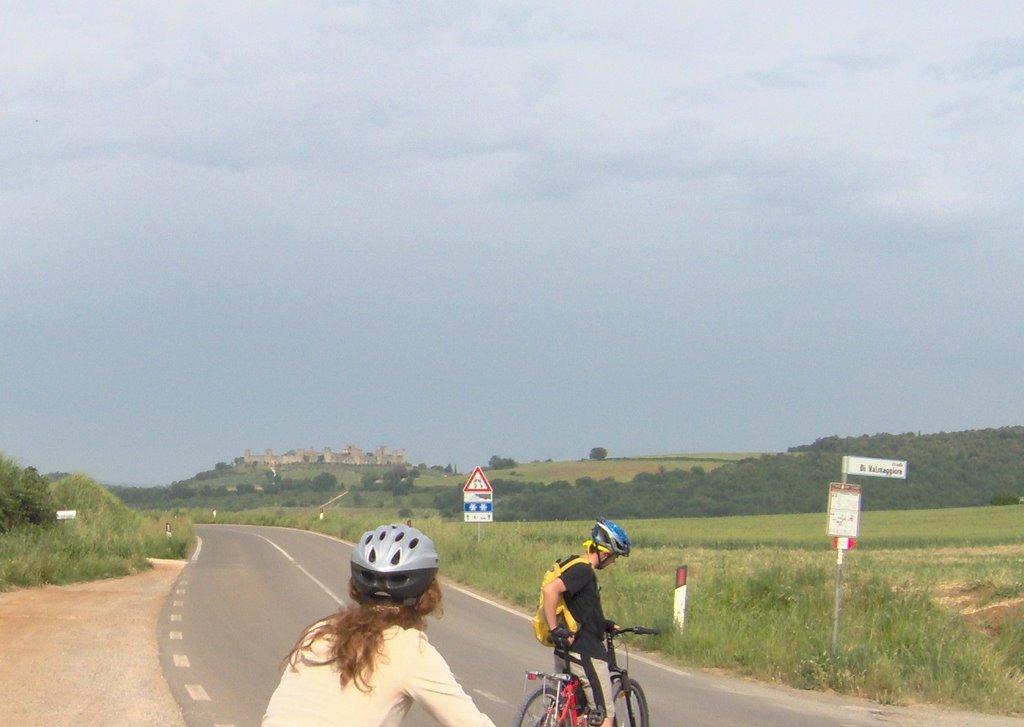
The biking was led by a gang of Italian guys, who were amused to tease Genevieve, our tour guide. In this last photo, you can see Genevieve and one of the Italian guys on bikes in the foreground. In the distance atop the hill is where we ate that night, in a restaurant also called Il Piccolo Castello, within Monteriggioni. It was a great meal.
Thursday, June 08, 2006
The Kentucky case cited by Attorney General McDonnell
Today in Richmond, Attorney General McDonnell is explaining his views on what happens if there is no budget as of July 1, when the old budget runs out.
Yesterday, he was in Abingdon, and in the Bristol paper's article, McDonnell mentioned that the Kentucky Supreme Court had ruled that Kentucky's governor could not appropriate funds on his own initiative after the Kentucky legislature adjourned in 2004 without a budget.
Here is the case, Fletcher v. Com. The Kentucky constitution contains an interesting prohibition against one branch of government intruding on the prerogatives of another: "No person or collection of persons being of one of those departments, shall exercise any power properly belonging to either of the others, except in the instances hereinafter expressly directed or permitted." This provision was apparently written by Thomas Jefferson:
"When Mr. Jefferson returned from France, the federal constitution had been adopted; and, having been appointed secretary of state, he obtained permission to go to Monticello for some months. John Breckinridge and George Nicholas paid him a visit there, and informed him that Kentucky was about to frame a constitution for herself, and that Virginia was about to permit Kentucky to become a separate and independent state. He told them that there was danger in the federal constitution, because the clause defining the powers of the departments of government was not sufficiently guarded, and that the first thing to be provided,for by the Kentucky constitution should be to confine the judiciary to its powers, and the legislative and executive to theirs. Mr. Jefferson drew the form of the provision, and gave it to Nicholas and Breckinridge; and it was taken by Nicholas to the convention which met at Danville, and there presented, - Breckinridge not being present at the convention. There was much discussion and dissent when the article was offered, but, when its author was made known, the respect of Kentucky for the great name of Jefferson carried it through, and it was at once adopted."
The Virginia Constitution contains a similar provision, Article III, section 1. The Virginia Constitution also contains language which says: "No money shall be paid out of the State treasury except in pursuance of appropriations made by law; and no such appropriation shall be made which is payable more than two years and six months after the end of the session of the General Assembly at which the law is enacted authorizing the same" Article X, section 7.
The Kentucky Supreme Court went on to quote James Madison, as having declared on the floor of the House of Representatives: "If there is a principle in our Constitution, indeed in any free Constitution more sacred than another, it is that which separates the legislative, executive and judicial powers."
The Court also noted the opinion of former U.S. Attorney General Benjamin Civiletti:
"A similar crisis occurred in the federal government in 1980 when it became apparent that Congress would not pass a federal budget or a budget continuation plan before October 1, the beginning of the next fiscal year. Former United States Attorney General Benjamin R. Civiletti opined, when interpreting 31 U .S.C. § 1341, the "Anti-Deficiency Act," which precludes any officer or employee of the government from making or authorizing the expenditure of unappropriated funds, that:
[S]tatutory authority to incur obligations in advance of appropriations . . . may not ordinarily be inferred, in the absence of appropriations, from the kind of broad, categorical authority, standing alone, that often appears, for example, in the organic statutes of governmental agencies. 5 Op. Off. Legal Counsel 1, 2 (1980) (quoted in 43 Op. Atty. Gen. 293, 297 (1981)).
We agree. Only those statutes specifically mandating that payments or contributions be made can be interpreted as self-executing appropriations. A mandated appropriation cannot be inferred from the mere existence of an unfunded statute."
The Kentucky Court concluded: "absent a statutory, constitutional, or valid federal mandate, Section 230 precludes the withdrawal of funds from the state treasury except pursuant to a specific appropriation by the General Assembly," and then undertook an analysis of the Governor's spending plan, to see whether there was some valid mandate that would allow the spending without legislation.
The Court rejected the Governor's argument, "that when the General Assembly fails to exercise its appropriations power to fund the operations of the executive department, he (the Governor) possesses the inherent power to order the appropriations necessary to prevent the imminent collapse of governmental services," concluding that "[i]f the legislative department fails to appropriate funds deemed sufficient to operate the executive department at a desired level of services, the executive department must serve the citizenry as best it can with what it is given."
UPDATE: The formal Attorney General opinion is here.
Yesterday, he was in Abingdon, and in the Bristol paper's article, McDonnell mentioned that the Kentucky Supreme Court had ruled that Kentucky's governor could not appropriate funds on his own initiative after the Kentucky legislature adjourned in 2004 without a budget.
Here is the case, Fletcher v. Com. The Kentucky constitution contains an interesting prohibition against one branch of government intruding on the prerogatives of another: "No person or collection of persons being of one of those departments, shall exercise any power properly belonging to either of the others, except in the instances hereinafter expressly directed or permitted." This provision was apparently written by Thomas Jefferson:
"When Mr. Jefferson returned from France, the federal constitution had been adopted; and, having been appointed secretary of state, he obtained permission to go to Monticello for some months. John Breckinridge and George Nicholas paid him a visit there, and informed him that Kentucky was about to frame a constitution for herself, and that Virginia was about to permit Kentucky to become a separate and independent state. He told them that there was danger in the federal constitution, because the clause defining the powers of the departments of government was not sufficiently guarded, and that the first thing to be provided,for by the Kentucky constitution should be to confine the judiciary to its powers, and the legislative and executive to theirs. Mr. Jefferson drew the form of the provision, and gave it to Nicholas and Breckinridge; and it was taken by Nicholas to the convention which met at Danville, and there presented, - Breckinridge not being present at the convention. There was much discussion and dissent when the article was offered, but, when its author was made known, the respect of Kentucky for the great name of Jefferson carried it through, and it was at once adopted."
The Virginia Constitution contains a similar provision, Article III, section 1. The Virginia Constitution also contains language which says: "No money shall be paid out of the State treasury except in pursuance of appropriations made by law; and no such appropriation shall be made which is payable more than two years and six months after the end of the session of the General Assembly at which the law is enacted authorizing the same" Article X, section 7.
The Kentucky Supreme Court went on to quote James Madison, as having declared on the floor of the House of Representatives: "If there is a principle in our Constitution, indeed in any free Constitution more sacred than another, it is that which separates the legislative, executive and judicial powers."
The Court also noted the opinion of former U.S. Attorney General Benjamin Civiletti:
"A similar crisis occurred in the federal government in 1980 when it became apparent that Congress would not pass a federal budget or a budget continuation plan before October 1, the beginning of the next fiscal year. Former United States Attorney General Benjamin R. Civiletti opined, when interpreting 31 U .S.C. § 1341, the "Anti-Deficiency Act," which precludes any officer or employee of the government from making or authorizing the expenditure of unappropriated funds, that:
[S]tatutory authority to incur obligations in advance of appropriations . . . may not ordinarily be inferred, in the absence of appropriations, from the kind of broad, categorical authority, standing alone, that often appears, for example, in the organic statutes of governmental agencies. 5 Op. Off. Legal Counsel 1, 2 (1980) (quoted in 43 Op. Atty. Gen. 293, 297 (1981)).
We agree. Only those statutes specifically mandating that payments or contributions be made can be interpreted as self-executing appropriations. A mandated appropriation cannot be inferred from the mere existence of an unfunded statute."
The Kentucky Court concluded: "absent a statutory, constitutional, or valid federal mandate, Section 230 precludes the withdrawal of funds from the state treasury except pursuant to a specific appropriation by the General Assembly," and then undertook an analysis of the Governor's spending plan, to see whether there was some valid mandate that would allow the spending without legislation.
The Court rejected the Governor's argument, "that when the General Assembly fails to exercise its appropriations power to fund the operations of the executive department, he (the Governor) possesses the inherent power to order the appropriations necessary to prevent the imminent collapse of governmental services," concluding that "[i]f the legislative department fails to appropriate funds deemed sufficient to operate the executive department at a desired level of services, the executive department must serve the citizenry as best it can with what it is given."
UPDATE: The formal Attorney General opinion is here.
Wednesday, June 07, 2006
Coal companies' cert. petition on West Virginia coal severance taxes denied
The WV Record reports here that the U.S. Supreme Court refused to take the case of the coal companies who brought a constitutional challenge to West Virginia's coal severance taxes. A similar challenge has been contemplated in Virginia.
Plethysmograph evidence meets the less rigid standard for admissibility in sentencing hearings
In Billips v. Com., the Virginia Court of Appeals, in an opinion by Judge Clements, joined by Judge Kelsey, with Judge Benton dissenting in part, affirmed the sentence imposed by a sex offender in a Tazewell County case. Judge Benton dissented on the issue of whether the Commonwealth failed to meet its burden of proving the reliability of the expert testimony it presented to show the likelihood that the defendant would want to commit other sex crimes. Judge Clements wrote that this evidence was admissible, based in part on the different standard for admissibility when the judge is hearing evidence on sentencing.
The opinion contains some interesting footnotes.
From Judge Clements:
"In Virginia, our Supreme Court specifically refused to adopt the Frye standard in O’Dell v. Commonwealth, 234 Va. 672, 696, 364 S.E.2d 491, 504 (1988), and acknowledged in John v. Im, 263 Va. 315, 322, 559 S.E.2d 694, 698 (2002), that it had not 'considered the question whether the Daubert analysis employed by the federal courts should be applied in our trial courts to determine the scientific reliability of expert testimony.' Thus, as the Supreme Court noted in John, the Spencer evidentiary standard still governs the admission of scientific evidence in Virginia. Id. at 322 n.3, 559 S.E.2d at 698 n.3."
From Judge Benton, who likened the disputed evidence to evidence from a polygraph:
"After decades of debate, the scientific community still has not agreed on the reliability of polygraphs, despite numerous studies on the question. See United States v. Scheffer, 523 U.S. 303, 309 (1998); see also 4 David L. Faigman, David H. Kaye, Michael J. Saks, & Joseph Sanders, Modern Scientific Evidence §§ 40:20 to 40:118, at 571-655 (2005) (discussing and analyzing the two sides of the continuing polygraph debate in the scientific community). While some studies concluded that polygraphs are highly accurate, others reported 50 and 51% accuracy rates. See Scheffer, 523 U.S. at 309 (citing S. Abrams, The Complete Polygraph Handbook 190-91 (1989); William G. Iacono & David T. Lykken, The Scientific Status of Research on Polygraph Techniques: The Case Against Polygraph Tests, in 1 Modern Scientific Evidence § 14-5.3 (1997)); see also 1 John W. Strong, McCormick on Evidence § 206, at 629 (5th ed. 1999) (summarizing the results of various studies conducted on polygraph reliability). One of the serious, lingering concerns about polygraphs is that an individual can “trick” the machine and receive a negative result despite lying. See Strong, supra (explaining the concern that “‘coaching’ and practicing would become more commonplace if the evidence were generally admissible”). “Although the degree of reliability of polygraph evidence may depend upon a variety of identifiable factors, there is simply no way to know in a particular case whether a polygraph examiner’s conclusion is accurate, because certain doubts and uncertainties plague even the best polygraph exams.” Scheffer, 523 U.S. at 312."
The opinion contains some interesting footnotes.
From Judge Clements:
"In Virginia, our Supreme Court specifically refused to adopt the Frye standard in O’Dell v. Commonwealth, 234 Va. 672, 696, 364 S.E.2d 491, 504 (1988), and acknowledged in John v. Im, 263 Va. 315, 322, 559 S.E.2d 694, 698 (2002), that it had not 'considered the question whether the Daubert analysis employed by the federal courts should be applied in our trial courts to determine the scientific reliability of expert testimony.' Thus, as the Supreme Court noted in John, the Spencer evidentiary standard still governs the admission of scientific evidence in Virginia. Id. at 322 n.3, 559 S.E.2d at 698 n.3."
From Judge Benton, who likened the disputed evidence to evidence from a polygraph:
"After decades of debate, the scientific community still has not agreed on the reliability of polygraphs, despite numerous studies on the question. See United States v. Scheffer, 523 U.S. 303, 309 (1998); see also 4 David L. Faigman, David H. Kaye, Michael J. Saks, & Joseph Sanders, Modern Scientific Evidence §§ 40:20 to 40:118, at 571-655 (2005) (discussing and analyzing the two sides of the continuing polygraph debate in the scientific community). While some studies concluded that polygraphs are highly accurate, others reported 50 and 51% accuracy rates. See Scheffer, 523 U.S. at 309 (citing S. Abrams, The Complete Polygraph Handbook 190-91 (1989); William G. Iacono & David T. Lykken, The Scientific Status of Research on Polygraph Techniques: The Case Against Polygraph Tests, in 1 Modern Scientific Evidence § 14-5.3 (1997)); see also 1 John W. Strong, McCormick on Evidence § 206, at 629 (5th ed. 1999) (summarizing the results of various studies conducted on polygraph reliability). One of the serious, lingering concerns about polygraphs is that an individual can “trick” the machine and receive a negative result despite lying. See Strong, supra (explaining the concern that “‘coaching’ and practicing would become more commonplace if the evidence were generally admissible”). “Although the degree of reliability of polygraph evidence may depend upon a variety of identifiable factors, there is simply no way to know in a particular case whether a polygraph examiner’s conclusion is accurate, because certain doubts and uncertainties plague even the best polygraph exams.” Scheffer, 523 U.S. at 312."
Tuesday, June 06, 2006
Attorney General McDonnell in Abingdon on Wednesday
I've read that Attorney General McDonnell will be at Virginia Highlands Community College tomorrow afternoon, although the nature of the event is not clear to me.
Perhaps one topic he will address will be the state of the Commonwealth in the absence of a budget. The Washington Post reports here and the Richmond paper reports here that the Attorney General has opined that Governor Kaine has limited power to keep the government running in the absence of appropriations from the legislature, if I understand these articles correctly.
Also of potential interest to a college group is the AG's opinion addressed to President Casteen of U.Va. that the University lacks authority under state procurement laws to include a "living wage" requirement in its contracts with private firms.
Perhaps one topic he will address will be the state of the Commonwealth in the absence of a budget. The Washington Post reports here and the Richmond paper reports here that the Attorney General has opined that Governor Kaine has limited power to keep the government running in the absence of appropriations from the legislature, if I understand these articles correctly.
Also of potential interest to a college group is the AG's opinion addressed to President Casteen of U.Va. that the University lacks authority under state procurement laws to include a "living wage" requirement in its contracts with private firms.
Monday, June 05, 2006
Oral argument in only 15% of Fourth Circuit cases?
This ACS post includes excerpts from an article about whether the federal appeals courts are too busy, which notes among other things that oral argument is heard in a smaller fraction of the cases, including as little as 15% in the 4th and 11th Circuits.
That seems like a strange statistic - is it evidence of a decline across all categories of cases, or merely a symptom of the explosion of criminal and prisoner litigation?
It seems to me that in just about every interesting civil case with lawyers on both sides, other than perhaps employment discrimination cases, there is oral argument, even in the Fourth Circuit. Perhaps I am mistaken.
That seems like a strange statistic - is it evidence of a decline across all categories of cases, or merely a symptom of the explosion of criminal and prisoner litigation?
It seems to me that in just about every interesting civil case with lawyers on both sides, other than perhaps employment discrimination cases, there is oral argument, even in the Fourth Circuit. Perhaps I am mistaken.
Saturday, June 03, 2006
And now . . . Newark
Having made it back to the United States, our plane back to Virginia has been delayed for at least two hours.
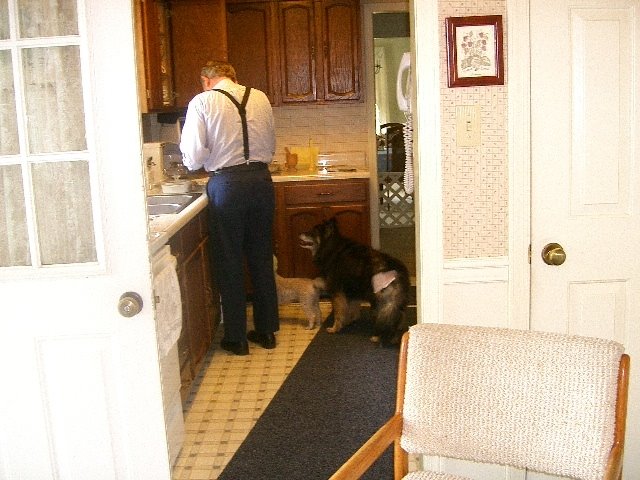
But, here is the best photo I've seen from the last week, better than any of the many that I've taken. It is of Dad drawing a crowd in his kitchen.
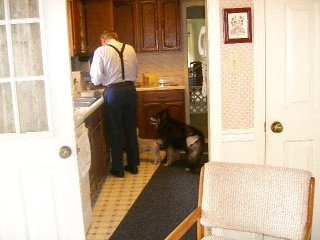
But, here is the best photo I've seen from the last week, better than any of the many that I've taken. It is of Dad drawing a crowd in his kitchen.
Thursday, June 01, 2006
On Judge Becker of the Third Circuit
This memorial of Judge Becker from the Third Circuit is very powerful (even when read during the siesta hour here in Rome).
Wednesday, May 31, 2006
Went to the Vatican
We went through the museums of the Vatican today, including the Sistine Chapel, then walked to the edge of St. Peter's square. The Pope was there, or so we were told. All we could see was that a bunch of people were at the other end of the piazza doing something.
Monday, May 29, 2006
Leaving Perugia
Tomorrow morning we end our organized tour of Tuscany and Umbria and go back to Rome for some disorganized time there.
Wednesday, May 24, 2006
Sunday, May 21, 2006
Made it to Rome
For anyone who's counting, we made it to Rome and saw the Colosseo and walked through the Forum ruins earlier today.
You'll have to take my word for it, since I did not manage to bring the USB cord for the camera.
I hope the old dog in her puppy prison cell is not too poorly.
You'll have to take my word for it, since I did not manage to bring the USB cord for the camera.
I hope the old dog in her puppy prison cell is not too poorly.
Wednesday, May 17, 2006
Out 'til June
There will be no new posting here until I get back from wherever all I need to be between now and June 3.
Monday, May 15, 2006
Who has standing to contest economic development giveaways?
In an opinion by Chief Justice Roberts, today in DaimlerChrysler Corp. v. Cuno, the Supreme Court held that the plaintiff taxpayer lacked standing to raise a challenge based on the Commerce Clause to tax breaks given to the defendant corporation by state and local government.
On Virginia government
I liked the line in this story from the Norfolk paper about the office space for the General Assembly, which says:
"The Trane Company has asked that the central chilling unit be donated to the corporation's museum when the state buys new equipment."
"The Trane Company has asked that the central chilling unit be donated to the corporation's museum when the state buys new equipment."
Sunday, May 14, 2006
On the bar exam and Chief Justice Hassell
I saw the Chief Justice at a dinner in Grundy on Friday night, and one interesting thing he said was that he receives a copy of the Virginia law questions on the bar exam twice a year and looks through to see if he knows the answers.
And, he said he thinks he would pass, since most of the questions are about rules or opinions that came from his Court, and many of them are repetitive of the questions from prior years.
And, he said he thinks he would pass, since most of the questions are about rules or opinions that came from his Court, and many of them are repetitive of the questions from prior years.
Virginia Tech and Richmond Law to have joint degree program
The Roanoke paper has this commentary on the new affiliation between Virginia Tech's College of Science and the University of Richmond law school.
It says in part:
"Before the joint program was announced, the College of Science seemed to have as much in common with the T.C. Williams School of Law as nanotubes have with legal pads. But the union makes sense for law students with an inclination toward the sciences."
I listened to what amounts to a chemistry lecture myself, earlier in the week. It makes sense to me, to have lawyers (and judges) with science degrees.
It says in part:
"Before the joint program was announced, the College of Science seemed to have as much in common with the T.C. Williams School of Law as nanotubes have with legal pads. But the union makes sense for law students with an inclination toward the sciences."
I listened to what amounts to a chemistry lecture myself, earlier in the week. It makes sense to me, to have lawyers (and judges) with science degrees.
The Roger Keith Coleman story in the Washington Post
I finally got around to reading the story in the Washington Post by Glenn Frankel as a postscript on the Roger Keith Coleman case.
The article quotes Tom Scott, John Tucker, and Trey Smith, among others. I saw Tom and Mickey McGlothlin on Friday night.
The article quotes Tom Scott, John Tucker, and Trey Smith, among others. I saw Tom and Mickey McGlothlin on Friday night.
Why is that brown car driving so slowly between Abingdon and Bristol
In this article, Edmunds.com takes on how to increase your gas mileage.
And the answer seems to be, drive like my dad. Or like I do on mornings with no appointments, puttering down the interstate with the cruise control set on 60 mph, thinking about work, probably on the cell phone telling people about my latest brainwaves.
And the answer seems to be, drive like my dad. Or like I do on mornings with no appointments, puttering down the interstate with the cruise control set on 60 mph, thinking about work, probably on the cell phone telling people about my latest brainwaves.
More links on Fourth Circuit vacancies
Howard Bashman links here and here to an article in the Richmond paper and an editorial in the Washington Times, both pointing out how the White House need to get a move on with respect to vacancies on the Fourth Circuit.
Second judge from among the alumni of Regent Law
This press release indicates that a second graduate from the Regent University law school has been made a state court judge in Virginia.
Who will be the first graduate of the Appalachian School of Law to be made a judge? I wonder.
Who will be the first graduate of the Appalachian School of Law to be made a judge? I wonder.
Who wouldn't want to be an appeals court judge?
With the talk lately about Judge Luttig's departure from the Fourth Circuit, the anonymous author of HOWT has this post saying that being an appellate judge is a pretty good deal, despite the "low" pay.
He (or maybe she) says in part:
"First, I really enjoy the intellectual stimulation of wrestling with the finer points of the law. Second, I enjoy writing and I find a lot of satisfaction in crafting an opinion that resolves the legal issues between the parties and provides future guidance to the bench and bar. Finally, there are some great quality of life benefits in that you don't have to worry about clients or billable hours and because the job is 90% reading and 10% writing, you can do it anywhere and anytime. This means that the hours are pretty flexible and as long as you have the discipline to keep up with the work flow, I can go to my kids' sporting events, parent-teacher conferences and all those other things I missed before I went on the bench."
He (or maybe she) says in part:
"First, I really enjoy the intellectual stimulation of wrestling with the finer points of the law. Second, I enjoy writing and I find a lot of satisfaction in crafting an opinion that resolves the legal issues between the parties and provides future guidance to the bench and bar. Finally, there are some great quality of life benefits in that you don't have to worry about clients or billable hours and because the job is 90% reading and 10% writing, you can do it anywhere and anytime. This means that the hours are pretty flexible and as long as you have the discipline to keep up with the work flow, I can go to my kids' sporting events, parent-teacher conferences and all those other things I missed before I went on the bench."
Saturday, May 13, 2006
On qualified immunity
I read with great interest the Fourth Circuit's opinion in the case of Ridpath v. Board of Governors, and find much noteworthy within it.
For one thing, the Court splits 2-1 on the issue of whether the plaintiff has stated a due process/liberty claim. If three Fourth Circuit judges cannot agree, that's pretty good evidence to me that the constitutional right asserted by the plaintiff is not clearly established. If it's not clear to Judge Widener that the plaintiff has a claim, how could the defendants have known any better?
The case is about some guy suing a football coach and Marshall University administrators for throwing the blame on him for an NCAA rules violation, with the result that the NCAA ruled that part of the "corrective action" the University should take was to correct the plaintiff out of his job, which in turn made him untouchable in the NCAA compliance racket. That "liberty interest" area of the law seems like murky territory to me - I've never seen one get past a motion to dismiss. Judge Widener might be right in his dissent when he focuses on the case law that says defamation is not a constitutional violation. There is something fuzzy about this claim, to my mind, and it has to do with the interaction between the University and the NCAA. Fuzzy claims, one would hope, are the ones on which the defendants are entitled to qualfied immunity.
Second, there is a footnote bashing citation to unpublished case law. I have always believed that qualified immunity is one sub-issue where the unpublished law frequently ought to be considered, not for the purpose of considering what the law is, but for the secondary and sometimes historical issue of whether the right at issue was not clearly established. The Court says in footnote 15: "On this issue and others, the Administrators extensively rely on unpublished decisions of this Court. Of course, under Local Rule 36(c), citations to unpublished decisions are disfavored. These citations might be warranted if, for example, there were no published decision on point. Because such circumstances are not present here, however, we do not address the unpublished decisions cited by the Administrators." Now, I don't know what the lawyers were doing in this case, but I know what I was trying to do when I have cited unpublished case when litigating qualified immunity in the past. I suspect, however, that Local Rule 36(c) will not present the same obstacle on this point as it has in the past, once the rules change takes effect on citation to unpublished opinions.
Third, on the First Amendment question, the panel refers to "the McVey rule." I was the lawyer for the defendants in the McVey case. It seemed to me at the time like a very good case for determination on the pleadings, because the plaintiff's First Amendment claim was based entirely on an innocuous writing that was made a part of the complaint. The majority notes in its footnotes that its decision does not preclude the individuals from relitigating qualified immunity on summary judgment. And, so we did in McVey, and won the case, which judgment was affirmed on appeal. 44 Fed.Appx. 630 (4th Cir. 2002). In McVey, the original panel agreed 3-0 that the denial of the motion to dismiss should be affirmed, but otherwise was split 1-1-1 in a curious sort of way. Judge Niemeyer wrote that if the facts turn out one way, the defendants would win; Judge Murnaghan wrote that if the facts turn out another way, the defendants would lose; and Judge Michael wrote in the manner of that fellow in the movie Oh, Brother, Where Art Thou?, who said "I'm for yours truly, too." Actually, what he wrote was this: "I concur in Judge Niemeyer's opinion for the court, except to the extent it is qualified by Judge Murnaghan's separate opinion. In addition, I concur in the judgment." McVey v. Stacy, 157 F.3d 271, 282 (4th Cir. 1998) (Michael, J., concurring in part and concurring in judgment).
And so it is that I will be unable to hit the lecture circuit explaining the McVey rule, when it has puzzled me like a Rubik's cube in some aspects for almost a decade.
Fourth, the majority variously cites Jenkins v. Medford. Jenkins is the poster child for qualified immunity appeals of motions to dismiss. Judge Ervin in his dissent in Jenkins bemoaned the way the majority had taken the issue of qualified immunity and come out with an opinion that said the plaintiff could not state a claim, when there were all kinds of facts that remained unknown. I suspect that the Jenkins case has done in the political firing claims of road deputies in four states.
Finally, the lawyers for the defendants do not seem to have done themselves any favors, as they have boogered up some of the procedure. One appellant was booted out for lack of standing because he had not raised qualified immunity at all in the district court. As to the others, the official capacity appellants were booted because qualified immunity has nothing to do with official capacity defendants. As to the remaining individuals, the Court had to consider whether it could consider their qualified immunity claims, when they were not raised in the answers or any motions to dismiss, but instead in the third round of briefing motions to dismiss.
For one thing, the Court splits 2-1 on the issue of whether the plaintiff has stated a due process/liberty claim. If three Fourth Circuit judges cannot agree, that's pretty good evidence to me that the constitutional right asserted by the plaintiff is not clearly established. If it's not clear to Judge Widener that the plaintiff has a claim, how could the defendants have known any better?
The case is about some guy suing a football coach and Marshall University administrators for throwing the blame on him for an NCAA rules violation, with the result that the NCAA ruled that part of the "corrective action" the University should take was to correct the plaintiff out of his job, which in turn made him untouchable in the NCAA compliance racket. That "liberty interest" area of the law seems like murky territory to me - I've never seen one get past a motion to dismiss. Judge Widener might be right in his dissent when he focuses on the case law that says defamation is not a constitutional violation. There is something fuzzy about this claim, to my mind, and it has to do with the interaction between the University and the NCAA. Fuzzy claims, one would hope, are the ones on which the defendants are entitled to qualfied immunity.
Second, there is a footnote bashing citation to unpublished case law. I have always believed that qualified immunity is one sub-issue where the unpublished law frequently ought to be considered, not for the purpose of considering what the law is, but for the secondary and sometimes historical issue of whether the right at issue was not clearly established. The Court says in footnote 15: "On this issue and others, the Administrators extensively rely on unpublished decisions of this Court. Of course, under Local Rule 36(c), citations to unpublished decisions are disfavored. These citations might be warranted if, for example, there were no published decision on point. Because such circumstances are not present here, however, we do not address the unpublished decisions cited by the Administrators." Now, I don't know what the lawyers were doing in this case, but I know what I was trying to do when I have cited unpublished case when litigating qualified immunity in the past. I suspect, however, that Local Rule 36(c) will not present the same obstacle on this point as it has in the past, once the rules change takes effect on citation to unpublished opinions.
Third, on the First Amendment question, the panel refers to "the McVey rule." I was the lawyer for the defendants in the McVey case. It seemed to me at the time like a very good case for determination on the pleadings, because the plaintiff's First Amendment claim was based entirely on an innocuous writing that was made a part of the complaint. The majority notes in its footnotes that its decision does not preclude the individuals from relitigating qualified immunity on summary judgment. And, so we did in McVey, and won the case, which judgment was affirmed on appeal. 44 Fed.Appx. 630 (4th Cir. 2002). In McVey, the original panel agreed 3-0 that the denial of the motion to dismiss should be affirmed, but otherwise was split 1-1-1 in a curious sort of way. Judge Niemeyer wrote that if the facts turn out one way, the defendants would win; Judge Murnaghan wrote that if the facts turn out another way, the defendants would lose; and Judge Michael wrote in the manner of that fellow in the movie Oh, Brother, Where Art Thou?, who said "I'm for yours truly, too." Actually, what he wrote was this: "I concur in Judge Niemeyer's opinion for the court, except to the extent it is qualified by Judge Murnaghan's separate opinion. In addition, I concur in the judgment." McVey v. Stacy, 157 F.3d 271, 282 (4th Cir. 1998) (Michael, J., concurring in part and concurring in judgment).
And so it is that I will be unable to hit the lecture circuit explaining the McVey rule, when it has puzzled me like a Rubik's cube in some aspects for almost a decade.
Fourth, the majority variously cites Jenkins v. Medford. Jenkins is the poster child for qualified immunity appeals of motions to dismiss. Judge Ervin in his dissent in Jenkins bemoaned the way the majority had taken the issue of qualified immunity and come out with an opinion that said the plaintiff could not state a claim, when there were all kinds of facts that remained unknown. I suspect that the Jenkins case has done in the political firing claims of road deputies in four states.
Finally, the lawyers for the defendants do not seem to have done themselves any favors, as they have boogered up some of the procedure. One appellant was booted out for lack of standing because he had not raised qualified immunity at all in the district court. As to the others, the official capacity appellants were booted because qualified immunity has nothing to do with official capacity defendants. As to the remaining individuals, the Court had to consider whether it could consider their qualified immunity claims, when they were not raised in the answers or any motions to dismiss, but instead in the third round of briefing motions to dismiss.
The car wreck that cost the West Virginia chief justice the election
WV Record has this analysis of the claim being made by the former Chief Justice of the West Virginia Supreme Court that he lost the election because his injuries from a car wreck on which he has now filed suit, seeking lost wages for his former position, left him looking kind of weird at a campaign appearance that was filmed and used against him in television commercials.
Qwest and Osama
One of my good lawyer friends included this post on his daily list of links, and it pertains to the NSA phone call database, reaching this conclusion: "Perhaps Osama is holed up in a mountainous tribal region where even the telephone companies are not controlled by federal authorities? I've got it! Bush can't find Osama because Qwest won't cooperate!"
Oddly enough, my long distance carrier is Qwest, and I'm in that other mountainous tribal region, Southwest Virginia.
Oddly enough, my long distance carrier is Qwest, and I'm in that other mountainous tribal region, Southwest Virginia.
Friday, May 12, 2006
Of Cossacks, Pandora, dastardly deeds, wholesale campaigns, and knights in shining armor
This great article from the Bristol paper contains a lot of Wise County lawyer-speak.
The gist is that the defendants in the Appalachian election fraud case are complaining that the Commonwealth's attorney is telling the witnesses they don't have to talk to the defense lawyers. The paper's website has this link to one defendant's motion, which refers to the conduct of the Commonwealth, "through its knights in shining armor."
It all kind of makes you want to get in on a case like that.
The gist is that the defendants in the Appalachian election fraud case are complaining that the Commonwealth's attorney is telling the witnesses they don't have to talk to the defense lawyers. The paper's website has this link to one defendant's motion, which refers to the conduct of the Commonwealth, "through its knights in shining armor."
It all kind of makes you want to get in on a case like that.
Norfolk federal court building to go up not out?
The Norfolk paper reports here that the latest plans on expanding the federal courthouse in downtown Norfolk are to go up in the air.
The article says that unnamed courthouse employees are bummed at the thought of holding court while all the necessary construction work is being conducted.
The article says that unnamed courthouse employees are bummed at the thought of holding court while all the necessary construction work is being conducted.
Does the Cowboy Church buck heads with Bedford zoning?
This fine article says that officials in Bedford County are cracking down on the Cowboy Church (on Horseshoe Bend Road) as being a non-permitted use under the zoning ordinance.
Representatives of the Cowboy Church threaten legal action, including resort to the Religious Land Use and Institutionalized Persons Act. They say: "If he was having a square dance, nobody would have bothered him."
What the article does not explain is, what is the Cowboy Church? And, what are all these cowboys doing in Virginia?
Representatives of the Cowboy Church threaten legal action, including resort to the Religious Land Use and Institutionalized Persons Act. They say: "If he was having a square dance, nobody would have bothered him."
What the article does not explain is, what is the Cowboy Church? And, what are all these cowboys doing in Virginia?
Thursday, May 11, 2006
The factsheet on Judge Boyle
Via Howard Bashman, former clerks for Fourth Circuit nominee Judge Boyle are circulating this factsheet in response to the Salon.com article about him.
Another black eye for the ABA on rating judges?
As reported here in the Washington Post, the ABA committee has decided unanimously that Michael Wallace, who went to Harvard and U.Va. Law and clerked for Justice Rehnquist, is unqualified for confirmation to the Fifth Circuit.
That seems odd, but then I read here and here and here that Wallace was impeachment counsel for Senator Lott, and it seems simply suspicious - either the committee has completely lost its bearings or they found out something horrible about the nominee. This is the same committee that said nominees Boyle, Owen, Alito, and Roberts are well qualified, and at one time said that Myers, Pryor, Brown, and Griffith are qualified.
It appears that there's a U.Va. man on the committee, but the nominee didn't even get his vote.
That seems odd, but then I read here and here and here that Wallace was impeachment counsel for Senator Lott, and it seems simply suspicious - either the committee has completely lost its bearings or they found out something horrible about the nominee. This is the same committee that said nominees Boyle, Owen, Alito, and Roberts are well qualified, and at one time said that Myers, Pryor, Brown, and Griffith are qualified.
It appears that there's a U.Va. man on the committee, but the nominee didn't even get his vote.
Wednesday, May 10, 2006
Pam Reeves in the hunt for Tennessee AG
On the Tennessee side, Knoxville lawyer Pam Reeves, a former president of the Tennessee Bar Association with some ties to Bristol (and who was born in Marion, Virginia), is after the position of Attorney General for Tennessee, according to this report.
So far as I know, she has the full support of all the bloggers on Johnson Street in Bristol, Virginia.
So far as I know, she has the full support of all the bloggers on Johnson Street in Bristol, Virginia.
On Judge Luttig's resignation
I was quite surprised to hear on the radio this afternoon that Judge Michael Luttig of the Fourth Circuit is leaving the bench for a job with private industry. The Washington Post has this report, and the New York Times has this report.
Looking at what's left on the Fourth Circuit, Judge Boyle remains unconfirmed, Mr. Haynes remains unconfirmed to replace Judge Widener (who was born in 1923 and has been on the Court for 34 years), no one has been named to replace Claude Allen as the nominee to replace the late Judge Murnaghan, and now there will be a fourth vacancy. At the current rate, none of those vacancies will be filled during the term of President Bush.
Here's my two cents, unvarnished by any notion of politics: There are three district judges in Maryland - Quarles, Bennett (who does sort of look like the President), and Titus (who does sort of look like the Vice-President) - who have been confirmed by the Senate during the Bush administration - any of them could be confirmed to a seat on the Fourth Circuit. Judge Spencer from Richmond or Judge Smith from Norfolk - or maybe Judge Kelsey of the Virginia Court of Appeals - would be good choices to succeed Judge Luttig. Don't dilly-dally.
Looking at what's left on the Fourth Circuit, Judge Boyle remains unconfirmed, Mr. Haynes remains unconfirmed to replace Judge Widener (who was born in 1923 and has been on the Court for 34 years), no one has been named to replace Claude Allen as the nominee to replace the late Judge Murnaghan, and now there will be a fourth vacancy. At the current rate, none of those vacancies will be filled during the term of President Bush.
Here's my two cents, unvarnished by any notion of politics: There are three district judges in Maryland - Quarles, Bennett (who does sort of look like the President), and Titus (who does sort of look like the Vice-President) - who have been confirmed by the Senate during the Bush administration - any of them could be confirmed to a seat on the Fourth Circuit. Judge Spencer from Richmond or Judge Smith from Norfolk - or maybe Judge Kelsey of the Virginia Court of Appeals - would be good choices to succeed Judge Luttig. Don't dilly-dally.
The ABA on the NSA wiretap program
Ars Technica has this post with links and a description of a collection of point/counterpoint essays collected by the American Bar Association on the legality of the NSA warrantless wiretap program.
Sunday, May 07, 2006
On making new lawyers
The May edition of the ABA Journal has this account of the current debate about the efficacy of law school as we know it.
The graduation speech list, Year IV
Some old, some new, all links good as of this minute:
Albert Einstein, Swarthmore, 1938
Franklin Roosevelt, University of Virginia, 1940
Ronald Reagan, Eureka College, 1957
Barbara Bush, Wellesley College, 1990
William Kunstler, University of Buffalo, 1995
Guy Kawasaki, Palo Alto High School, 1995
Kermit the Frog, LIU, 1996
Justice Stephen Breyer, Stanford, 1997
Bob Newhart, Catholic University, 1997
Patrick Buchanan, The Citadel, 1999
Tom and Ray Magliozzi, MIT, 1999
Conan O'Brien, Harvard, 2000
Ray Bradbury, Cal Tech, 2000
Chief Justice William Rehnquist, George Washington University, 2000
George W. Bush, Yale, 2001
Scott Turow, Northwestern, 2001
Wynton Marsalis, Connecticut College, 2001
Al Franken, Harvard, 2002
Christopher Reeve, Washington University School of Medicine, 2002
Fred Rogers, Dartmouth, 2002
Judge Janice Rogers Brown, Catholic University, 2003
Mortimer Caplin, University of Virginia, 2003
Elaine Chao, Regent University, 2003
Alan Greenspan, Wharton School, University of Pennsylvania, 2005
Steve Jobs, Stanford, 2005
Albert Einstein, Swarthmore, 1938
Franklin Roosevelt, University of Virginia, 1940
Ronald Reagan, Eureka College, 1957
Barbara Bush, Wellesley College, 1990
William Kunstler, University of Buffalo, 1995
Guy Kawasaki, Palo Alto High School, 1995
Kermit the Frog, LIU, 1996
Justice Stephen Breyer, Stanford, 1997
Bob Newhart, Catholic University, 1997
Patrick Buchanan, The Citadel, 1999
Tom and Ray Magliozzi, MIT, 1999
Conan O'Brien, Harvard, 2000
Ray Bradbury, Cal Tech, 2000
Chief Justice William Rehnquist, George Washington University, 2000
George W. Bush, Yale, 2001
Scott Turow, Northwestern, 2001
Wynton Marsalis, Connecticut College, 2001
Al Franken, Harvard, 2002
Christopher Reeve, Washington University School of Medicine, 2002
Fred Rogers, Dartmouth, 2002
Judge Janice Rogers Brown, Catholic University, 2003
Mortimer Caplin, University of Virginia, 2003
Elaine Chao, Regent University, 2003
Alan Greenspan, Wharton School, University of Pennsylvania, 2005
Steve Jobs, Stanford, 2005
Lawsuit threatened against the Commonwealth over skating event for the blind
The Norfolk paper reports here that a blind woman who fell down at a state-sponsored skating event plans to file suit for $1.5 million.
The article begins: "Perhaps it was a bad idea to strap skates on a blind woman and send her off unescorted around a roller rink. Perhaps not."
The article begins: "Perhaps it was a bad idea to strap skates on a blind woman and send her off unescorted around a roller rink. Perhaps not."
On lawyers misbehaving
The Norfolk paper reports here that a woman lawyer has complained that while she was working as an assistant prosecutor, a defense lawyer grabbed her by the throat.
Saturday, May 06, 2006
On a West Virginia lawyer being sued by a coal company
The West Virginia lawyer sued by a coal company said this:
"The biggest opponent of frivolous lawsuits has filed one against me. To hell with them."
"The biggest opponent of frivolous lawsuits has filed one against me. To hell with them."
On lawyers copying lawyers
As shown here and elsewhere, there is some discussion about whether lawyers can copy the writings of other lawyers without the risk of copyright infringement.
I know I do, every change I get, and it is getting easier all the time.
The No. 1 lawyer I try to copy, however, is myself - if the words were good then, and the law is still good now, why bother to rewrite it?
I know I do, every change I get, and it is getting easier all the time.
The No. 1 lawyer I try to copy, however, is myself - if the words were good then, and the law is still good now, why bother to rewrite it?
Springtime for (deleted)
Professor Bainbridge is bummed over schools who won't let teachers show kids the film, Blazing Saddles. I've seen an interview with Mel Brooks, where he explains the premise behind The Producers, along the same lines as the Bainbridge post.
Having read this post about a college football player who punched a horse, as did Alex Karras in the movie, I have to wonder about its influence on America's youth.
Having read this post about a college football player who punched a horse, as did Alex Karras in the movie, I have to wonder about its influence on America's youth.
11 months ago
At this meeting in Charlottesville, sitting at the table with Jeff Schapiro and Chad Dotson and Brian Patton, et al., I would have bet all the money in my pocket against Tim Kaine and the Chicago White Sox, but then again I'm not sure there was any money in my pocket.
If I can squeeze it in, I'll be there for Round Two - the 2006 Virginia blogger summit.
If I can squeeze it in, I'll be there for Round Two - the 2006 Virginia blogger summit.
On the verdict in the Earl Washington case
TalkLeft has this post, the Norfolk paper has this article, the Richmond paper has this story, and the Washington Post has this story on the $2.25 million verdict reached by the federal court jury in Charlottesville after a two week trial before Judge Moon.
ABA kicks self in shin
Nothing good can come of the ABA committee's determination (reported in these links from How Appealing) that the black woman nominated by President Bush to the U.S. district court in Connecticut deserves an "unqualified" rating.
The Hartford paper's article included this bit of perspective:
"Poor ratings are equally rare in Connecticut. Legal scholars contacted Friday could recall only two by the American Bar Association - one of former Republican Gov. Thomas J. Meskill and another of Hartford lawyer Joseph Adinolfi Jr., both in the 1970s. The scholars said Meskill and Adinolfi were not evaluated by the state bar association.
Most observers now attribute Meskill's unqualified rating to opposition to his political policies - opposition that was led by the faculty at the University of Connecticut's School of Law. Meskill was probably further hampered by the fact that his nomination was one of President Nixon's last official acts. Within days of nominating Meskill, Nixon resigned amid the Watergate scandal.
Nixon nominated Meskill to one of the most influential courts in the country, the U.S. Court of Appeals for the 2nd Circuit in New York, on the recommendation of Republican Sen. Lowell P. Weicker Jr. Despite the evaluation of not qualified, Meskill prevailed in the Senate in 1976, after President Ford endorsed the nomination and Weicker actively supported him.
Meskill continues to sit on the court of appeals and is highly regarded. He has received numerous awards from the state bar association, which one lawyer said Friday amount to a continuing apology for his treatment during his nomination process."
The Hartford paper's article included this bit of perspective:
"Poor ratings are equally rare in Connecticut. Legal scholars contacted Friday could recall only two by the American Bar Association - one of former Republican Gov. Thomas J. Meskill and another of Hartford lawyer Joseph Adinolfi Jr., both in the 1970s. The scholars said Meskill and Adinolfi were not evaluated by the state bar association.
Most observers now attribute Meskill's unqualified rating to opposition to his political policies - opposition that was led by the faculty at the University of Connecticut's School of Law. Meskill was probably further hampered by the fact that his nomination was one of President Nixon's last official acts. Within days of nominating Meskill, Nixon resigned amid the Watergate scandal.
Nixon nominated Meskill to one of the most influential courts in the country, the U.S. Court of Appeals for the 2nd Circuit in New York, on the recommendation of Republican Sen. Lowell P. Weicker Jr. Despite the evaluation of not qualified, Meskill prevailed in the Senate in 1976, after President Ford endorsed the nomination and Weicker actively supported him.
Meskill continues to sit on the court of appeals and is highly regarded. He has received numerous awards from the state bar association, which one lawyer said Friday amount to a continuing apology for his treatment during his nomination process."
Friday, May 05, 2006
Contractor loses license for using the homeless to remove asbestos
The Roanoke paper reports here on a contractor whose license has been revoked on account of using untrained homeless people to remove asbestos from a downtown Roanoke building.
Great profile of General District Court Judge Lookabill
The Roanoke paper has this delightful account of how the new general district court judge made it from shoe shine boy to the judiciary.
It begins:
"Popular imagination has it that judges, like others at the top of their field, are hard-driving people who knew what they wanted to be at 12 and sprinted and clawed after it.
But as recently sworn-in District Judge Royce Glenwood Lookabill tells it, his trajectory from shoeshine boy to the black robe is more a tale of random choices and auspicious breaks."
One such break was that one pair of shoes he used to shine belonged to Virginia Supreme Court Justice Alex Harman, for whom Judge Lookabill later clerked after law school.
It begins:
"Popular imagination has it that judges, like others at the top of their field, are hard-driving people who knew what they wanted to be at 12 and sprinted and clawed after it.
But as recently sworn-in District Judge Royce Glenwood Lookabill tells it, his trajectory from shoeshine boy to the black robe is more a tale of random choices and auspicious breaks."
One such break was that one pair of shoes he used to shine belonged to Virginia Supreme Court Justice Alex Harman, for whom Judge Lookabill later clerked after law school.
The secret docket
The Miami Herald is reporting on over 100 civil case files kept secret in a Florida courthouse.
Thursday, May 04, 2006
On the late Bob Ritchie
Here is an interesting recollection of a Knoxville lawyer, who had some cases here in Southwest Virginia.
The story concludes:
"In private, many lawyers are known to wax cynical about one client or another, or the criminal-defense line of work in general. I was kind of a wise guy myself, and tried, but could never work any cynicism out of Bob Ritchie. He believed in the criminal-justice system and in the daily importance of his part in it. Sometimes I even suspected that Bob Ritchie really believed his clients were innocent. It may take that willful belief, no matter how much energy it requires, to do that job as well as he did."
The story concludes:
"In private, many lawyers are known to wax cynical about one client or another, or the criminal-defense line of work in general. I was kind of a wise guy myself, and tried, but could never work any cynicism out of Bob Ritchie. He believed in the criminal-justice system and in the daily importance of his part in it. Sometimes I even suspected that Bob Ritchie really believed his clients were innocent. It may take that willful belief, no matter how much energy it requires, to do that job as well as he did."
Wednesday, May 03, 2006
Democrats get ready to fight over Judge Boyle?
TalkLeft has this post with a bunch of links outlining the opposition to the nomination of Judge Boyle of North Carolina to the Fourth Circuit.
I'm thinking that if Judge Boyle (and Mr. Kavanaugh) don't make it, Mr. Haynes won't make it, and there might still be at least two vacancies on the Fourth Circuit on January 20, 2009.
I'm thinking that if Judge Boyle (and Mr. Kavanaugh) don't make it, Mr. Haynes won't make it, and there might still be at least two vacancies on the Fourth Circuit on January 20, 2009.
That Steve in the Bible
From this Steve Dillard post, On Being Named Stephen, I recollect that the missionary fellow in the New Testament went around telling people exactly what he thought they were doing wrong and making them mad.
I've done a bit of that myself, but no rocks have been thrown to date.
I've done a bit of that myself, but no rocks have been thrown to date.
Monday, May 01, 2006
Another literary award
The secret judge has picked us once again as the winner of this week's Commonwealth Conservative caption contest.
I expected no more than an honorable mention, for most lines rhyming with "Martinsville". This was the first win since No. 38.
I expected no more than an honorable mention, for most lines rhyming with "Martinsville". This was the first win since No. 38.
Anna, Anna, Anna, Anna, Anna Nicole wins her Supreme Court case
Anna Nicole won her case before the Supreme Court. The opinion, styled Marshall v. Marshall, was released this morning, and the opinion for the Court was written by Justice Ginsburg, who concluded that the Ninth Circuit went overboard in its extension of the probate exception to federal court jurisdiction.
Sunday, April 30, 2006
All-time list of Cavaliers in the NFL draft
With D'Brickashaw Ferguson taken in the first round, I had occasion to revisit this list of all the Virginia players taken in the NFL draft (through 2003), and see that this is at least the third time a U.Va. man has been drafted by the Jets in the first round (the others being Jeff Lageman and James Farrior).
Subscribe to:
Posts (Atom)